
From the editor / Alberto Preato
The things people
make possible.
A route, a room, a registration system, a place to meet. The Journal grows from questions that travel between humanitarian work and everyday life.
Alberto Preato / Editor
Design, displacement
and the spaces between.
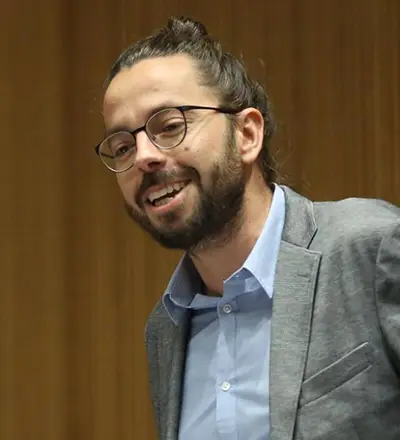
Alberto Preato is a Visiting Humanitarian Design Research Fellow at Fordham University’s Institute of International Humanitarian Affairs (IIHA). An architect by training and humanitarian practitioner, he works at the intersection of design, displacement, climate change, urban resilience and humanitarian action.
Over more than 15 years with the United Nations and other humanitarian and development partners, Alberto has worked across Africa, the Middle East, Latin America and the Caribbean, and the Pacific, including in some of the world’s most challenging post-disaster and post-conflict environments. His work has covered shelter and settlements, housing and community infrastructure, spatial planning, recovery, migration and displacement, and climate and disaster-risk resilience.
Across these settings, his work has increasingly focused on a simple question: how can design help humanitarian systems respond better to the realities of people living through crisis and displacement? Through research, teaching and practice, he explores the relationship between the spaces we create, the systems that shape them, and the dignity, resilience and agency of the people who use them.
Work locations
Verona (Italy) · London (UK) · New York (USA)
In Alberto’s own words / 1 October 2026
What interests me is therefore less whether people preserved the original design than what the design allowed them to do with it.
From A shelter is delivered. A home keeps changing.
In his public essays, Alberto connects his humanitarian and mobility work with an interest in design, beauty, cultural life and the choices people retain after an intervention ends. These are the published experiences and questions behind this Journal, in his own words.
Across places / Firsthand reflections
Different places.
A connected trajectory.
Select a place to read an excerpt from Alberto’s published account. These are contextual recollections, not current programme updates.
Routes & reception
In #Niger, the geography of the response was made of routes, transit centres, information, assistance, return and reintegration. Across the Venezuela response, people were moving through towns, cities and countries, and the questions were increasingly about reception, documentation, services, livelihoods, housing markets and urban incorporation.Read the surrounding passage
Three open questions