2019 / address
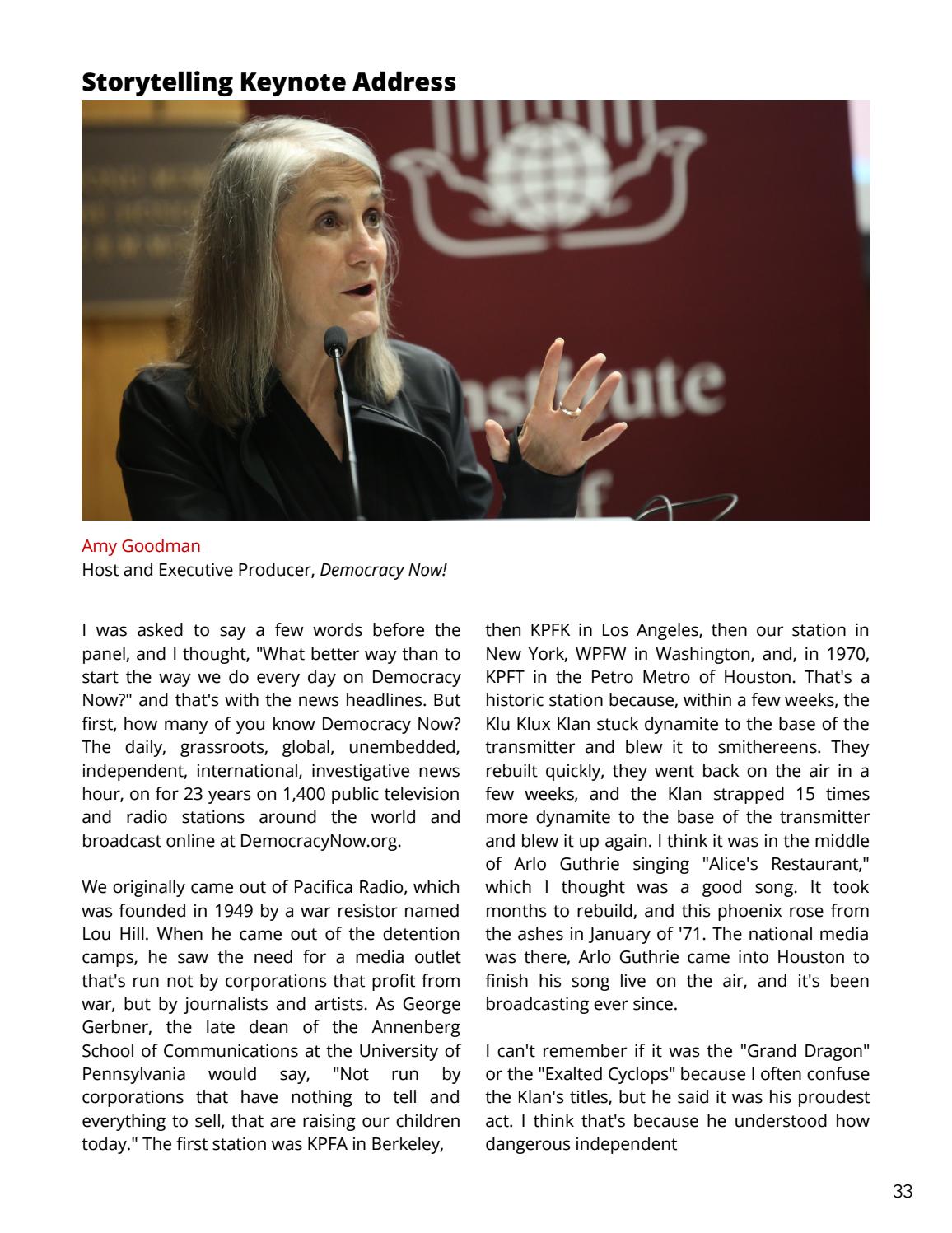
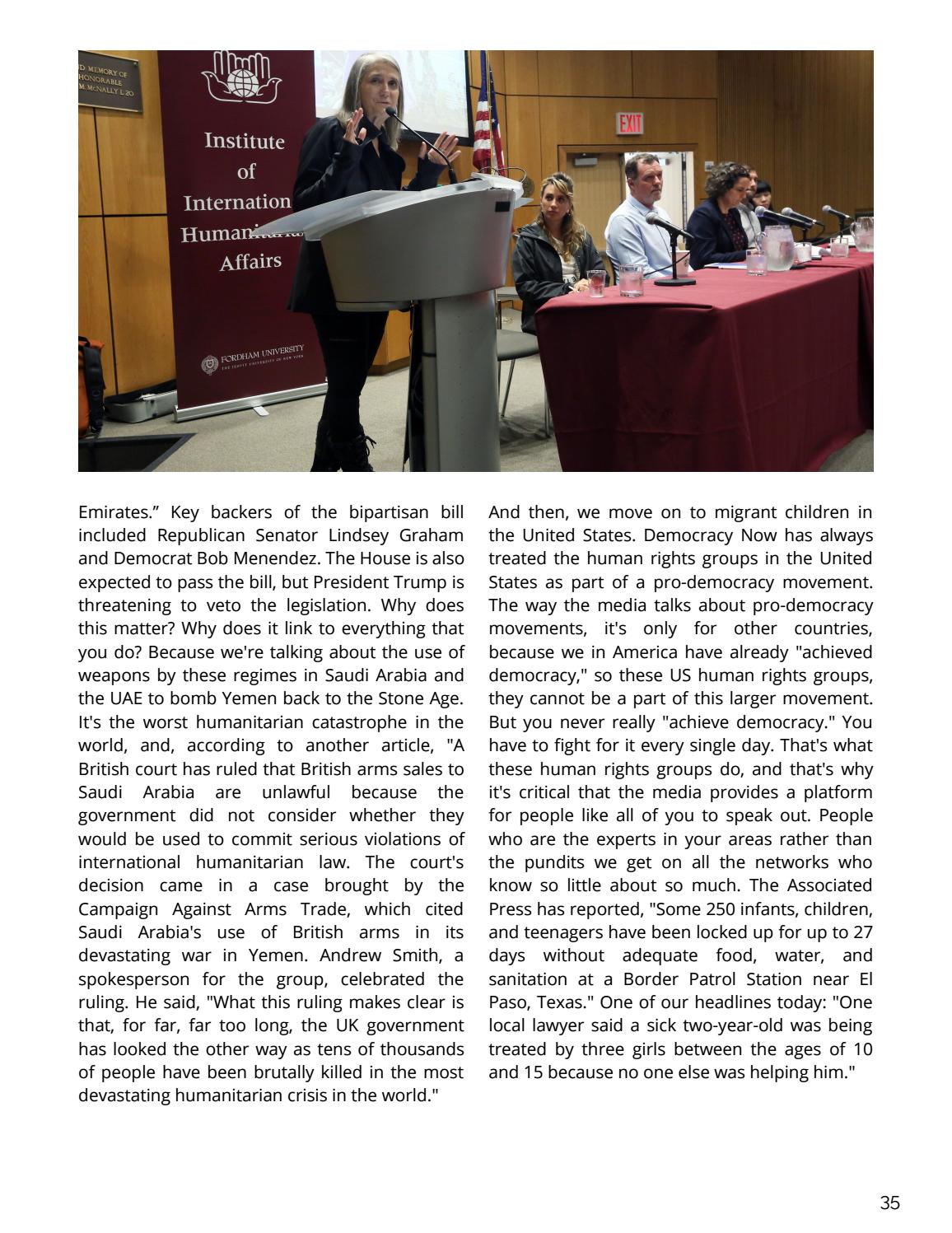
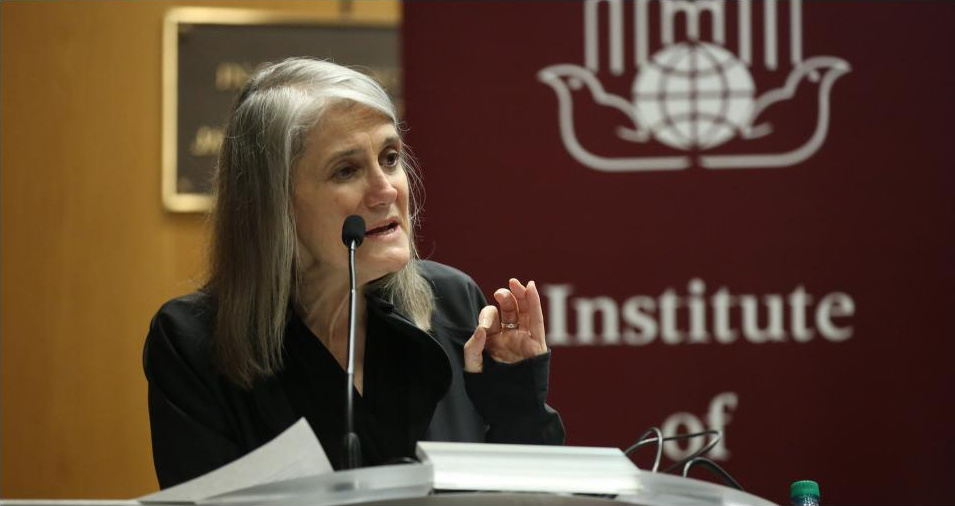
Storytelling Keynote Address
Host and Executive Producer, Democracy Now!
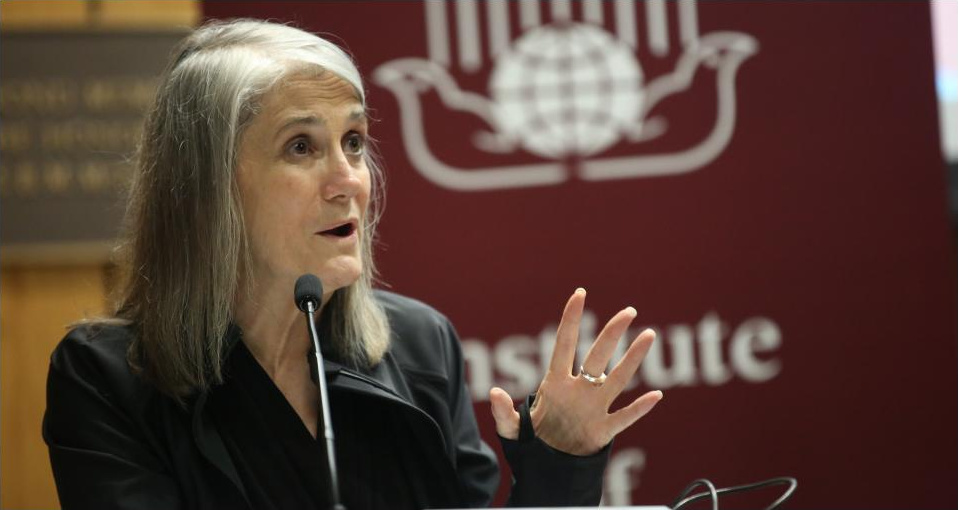
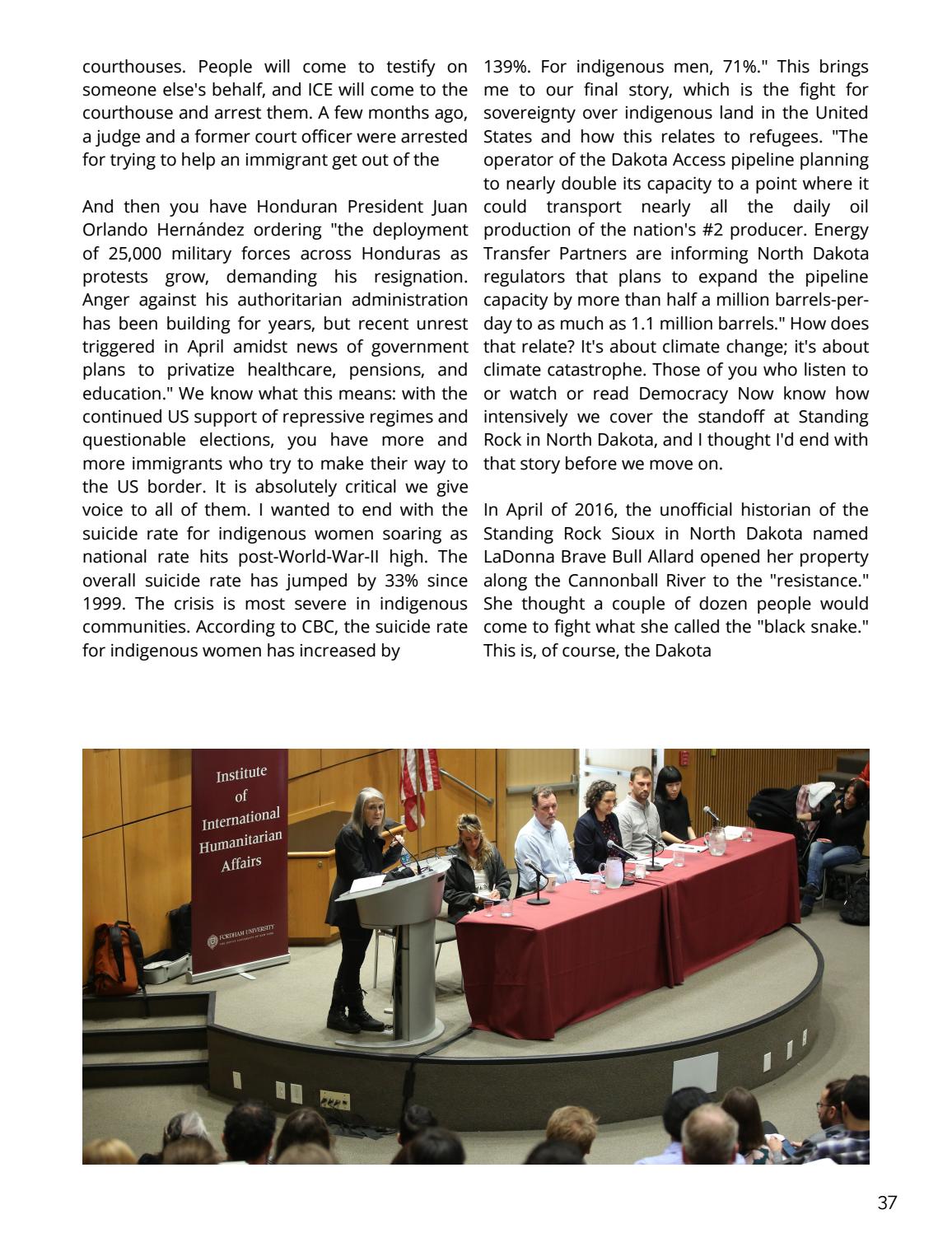
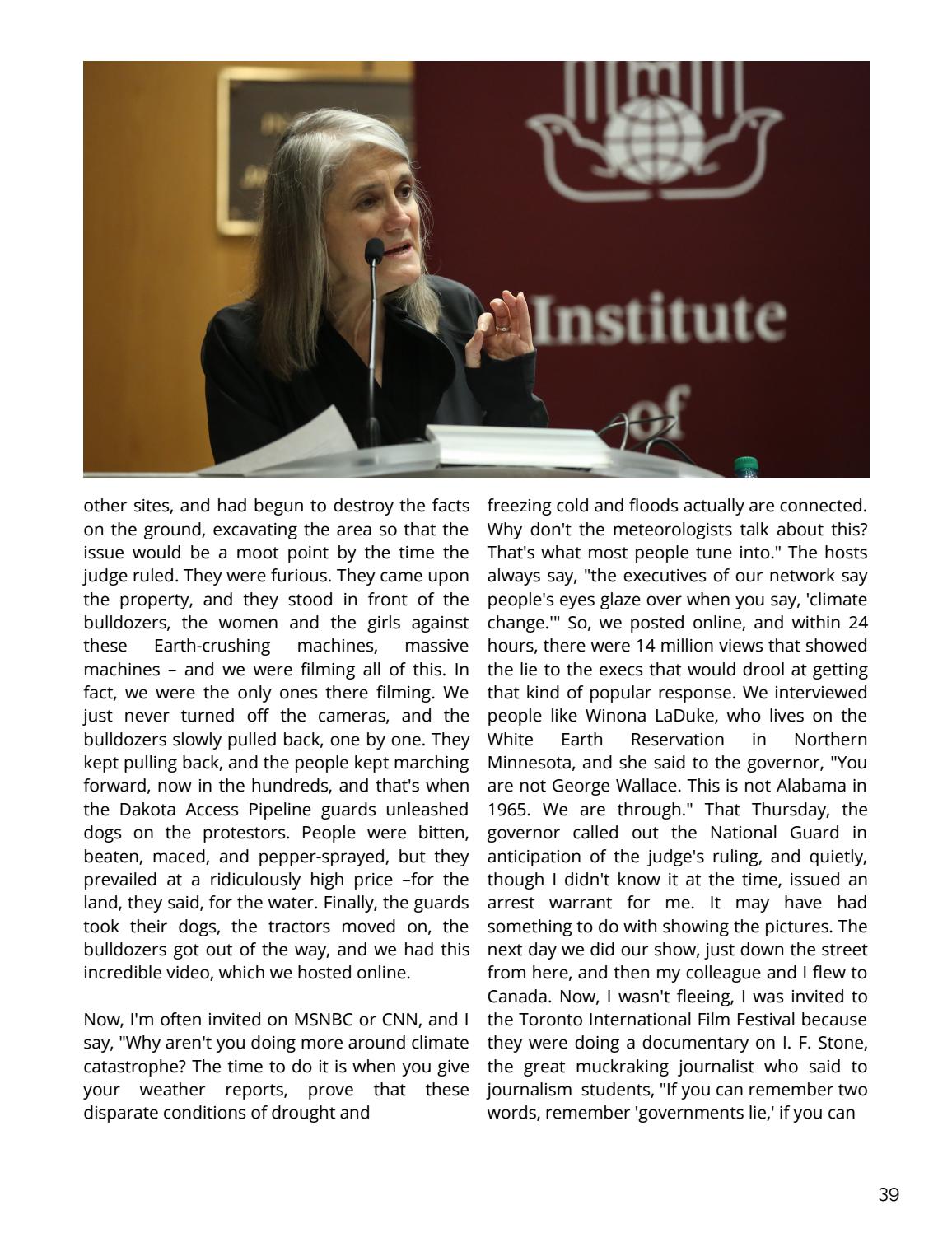
I was asked to say a few words before the panel, and I thought, "What better way than to start the way we do every day on Democracy Now?" and that's with the news headlines. But first, how many of you know Democracy Now? The daily, grassroots, global, unembedded, independent, international, investigative news hour, on for 23 years on 1,400 public television and radio stations around the world and broadcast online at DemocracyNow.org.
We originally came out of Pacifica Radio, which was founded in 1949 by a war resistor named Lou Hill. When he came out of the detention camps, he saw the need for a media outlet that's run not by corporations that profit from war, but by journalists and artists. As George Gerbner, the late dean of the Annenberg School of Communications at the University of Pennsylvania would say, "Not run by corporations that have nothing to tell and everything to sell, that are raising our children today." The first station was KPFA in Berkeley, then KPFK in Los Angeles, then our station in New York, WPFW in Washington, and, in 1970, KPFT in the Petro Metro of Houston. That's a historic station because, within a few weeks, the Klu Klux Klan stuck dynamite to the base of the transmitter and blew it to smithereens. They rebuilt quickly, they went back on the air in a few weeks, and the Klan strapped 15 times more dynamite to the base of the transmitter and blew it up again. I think it was in the middle of Arlo Guthrie singing "Alice's Restaurant," which I thought was a good song. It took months to rebuild, and this phoenix rose from the ashes in January of '71. The national media was there, Arlo Guthrie came into Houston to finish his song live on the air, and it's been broadcasting ever since.
I can't remember if it was the "Grand Dragon" or the "Exalted Cyclops" because I often confuse the Klan's titles, but he said it was his proudest act. I think that's because he understood how dangerous independent media is. Dangerous because it allows people to speak for themselves. When you hear someone speaking from their own experience, whether it's a Syrian climate refugee who we interviewed in the Calais Jungle in France during the UN Climate summit or a woman in Yemen whose sister was blown up during a US drone strike at a wedding party, whether it is a child in Afghanistan or an uncle in Iraq, you may not agree with them. I mean, how often do we even agree with our family members? But it makes it much less likely that you'll want to destroy them. I think that that understanding is the beginning of peace. The media can be the greatest force for peace on Earth; instead, it is all too often wielded as a weapon of war, and that's what we have to challenge. The reason the Klan wanted to destroy Pacifica is that when you hear someone speaking from their own experience, it breaks down the caricatures and the stereotypes that fuel hate groups. It breaks down the caricatures and stereotypes that allow you to separate yourself from that person. Instead, you say, "Oh my gosh, that Palestinian child sounds like my baby, that Israeli grandmother sounds like my bubbe." Suddenly, we care about what's happening. I think that is absolutely critical. The media laying the groundwork facilitates all of your humanitarian work because when there is a political will, there is no question: there is a way to deal with all of these issues. The magnificent plans you've laid out, both concrete accomplishments and your dreams for the future of displacement - that's the background of Democracy Now.
I just thought I'd start how we start every day, and that's with the headlines, and how, astoundingly, every headline links to refugees. This was our headline yesterday: "A New UN Report Finds Nearly 71 Million People were Displaced Last Year by War, Persecution, and Other Forms of Violence...the number is more than 2 million people higher than last year, represents a jump of 65% from a decade ago. Nearly 26 million refugees were recorded in 2018, over half of them under the age of 18, of these, less than 100,000 were resettled. Over 41 million people worldwide are internally displaced, and three and a half million were registered as asylum seekers." These numbers, I'm sure you are all quite familiar with.
Our top story today: "President Trump Reportedly Approving, then Abruptly Calling Off Military Strikes Targeting Iran Thursday Night,” with the New York Times reporting US Warplanes were already in the air, ready to attack, when Trump called the plan off. He'd initially okayed the strikes as retaliation for Iran downing a US drone. Iran maintains the drone had entered its airspace while the US claims the drone was in international waters. Trump's response to the first attack on the drone was to say, 'Iran made a big mistake, this drone was in international waters clearly, we have it all documented,’ he said, 'It's documented scientifically, not just words, and they made a very bad mistake." If only he respected science, would we be in this situation that we are in today with the UN, with the US pulling out of the UN Climate Accord, eviscerating yet another regulation around coal emissions in the United States? And just in the last few weeks, the Department of Energy announcing they will no longer use the word "methane," saying they will now call it "freedom gas," with one of the top officials at the Energy Department saying, "We are spreading molecules of freedom around the world."
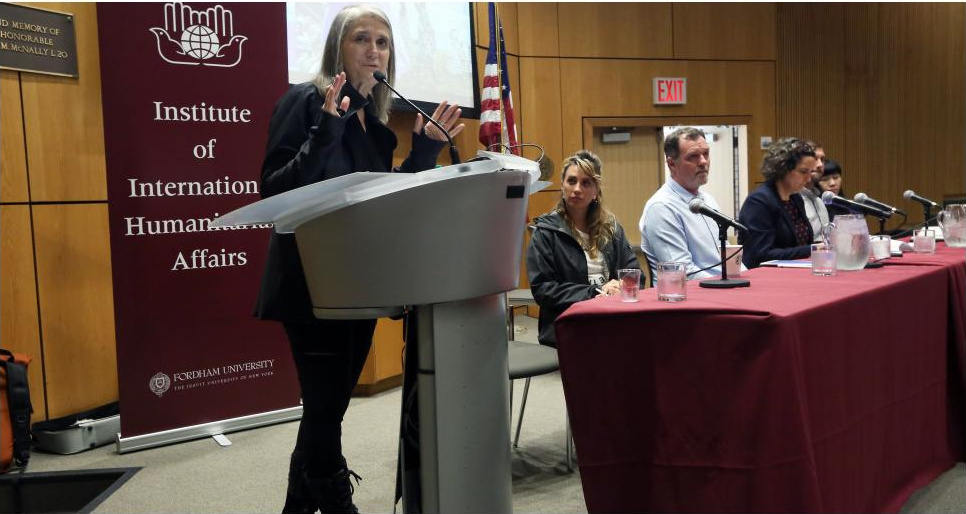
I want to move on to today's second headline: "The Republican-Led Senate Voted Yesterday to Block the Sale of Billions of Dollars’ Worth of Weapons to Saudi Arabia and the United Arab Emirates.” Key backers of the bipartisan bill included Republican Senator Lindsey Graham and Democrat Bob Menendez. The House is also expected to pass the bill, but President Trump is threatening to veto the legislation. Why does this matter? Why does it link to everything that you do? Because we're talking about the use of weapons by these regimes in Saudi Arabia and the UAE to bomb Yemen back to the Stone Age. It's the worst humanitarian catastrophe in the world, and, according to another article, "A British court has ruled that British arms sales to Saudi Arabia are unlawful because the government did not consider whether they would be used to commit serious violations of international humanitarian law. The court's decision came in a case brought by the Campaign Against Arms Trade, which cited Saudi Arabia's use of British arms in its devastating war in Yemen. Andrew Smith, a spokesperson for the group, celebrated the ruling. He said, "What this ruling makes clear is that, for far, far too long, the UK government has looked the other way as tens of thousands of people have been brutally killed in the most devastating humanitarian crisis in the world."
And then, we move on to migrant children in the United States. Democracy Now has always treated the human rights groups in the United States as part of a pro-democracy movement. The way the media talks about pro-democracy movements, it's only for other countries, because we in America have already "achieved democracy," so these US human rights groups, they cannot be a part of this larger movement. But you never really "achieve democracy." You have to fight for it every single day. That's what these human rights groups do, and that's why it's critical that the media provides a platform for people like all of you to speak out. People who are the experts in your areas rather than the pundits we get on all the networks who know so little about so much. The Associated Press has reported, "Some 250 infants, children, and teenagers have been locked up for up to 27 days without adequate food, water, and sanitation at a Border Patrol Station near El Paso, Texas." One of our headlines today: "One local lawyer said a sick two-year-old was being treated by three girls between the ages of 10 and 15 because no one else was helping him."
Children have reportedly been fed uncooked frozen food or rice, have gone weeks without bathing or clean clothes. Attorney Holly Cooper said, "In my 22 years of doing visits with children in detention, I have never heard of this level of inhumanity." This comes as the Trump administration argued this week in federal court that the government is not required to provide toothbrushes, soap, or beds to children who are detained along the border.
The Justice Department attorney Sarah Fabian made the argument before an incredulous three-judge panel of the Ninth US Circuit Court of Appeals in San Francisco. All three judges repeatedly questioned the government's claim. Judge Wallace Tashima said, "If you don't have a toothbrush, if you don't have soap, if you don't have a blanket, it's not safe and sanitary, wouldn't everybody agree with that? Do you agree with that?" The Justice Department lawyer said, "there is fair reason to find that those things may be part of 'safe and sanitary'." The judge said, "Not maybe. Are a part. What do you say, maybe? You mean there are circumstances when a person doesn't need a toothbrush, toothpaste, and soap for days?" The lawyer replied, "Well, I think Customs and Border Patrol Custody, its frequently intended to be much shorter term," so Judge Marsha Berzon also pointed out the kids sleep on cement floors. She said, "Are you really gonna stand up and tell us being able to sleep isn't a question of 'safe and sanitary conditions?'" The Justice Department lawyer said, "Your Honor, I think what I'd like to —" "No," she said. "You're not really going to say that," the judge said. And the lawyer responded, "I'd like to really focus in on what your question is."
I want to turn to the protest that's going to be planned, as a group of Japanese-Americans who were once held in US internment camps is planning to protest outside Fort Sill, tomorrow in Oklahoma. "During World War II, the US government imprisoned about 700 people of Japanese ancestry at Fort Sill. There were over 100,000 Japanese and Japanese-Americans imprisoned around the United States. Earlier this month, the Trump Administration announced it is soon starting to hold migrant children at Fort Sill."
And then to Colorado, a case we have followed continuously. Immigrant rights activist Jeanette Vizguerra has just been denied an application for a visa in her latest attempt to stay in the US, where she has lived for more than a quarter of a century. Earlier this year, Vizguerra took sanctuary at the First Unitarian Society of Denver Church after her stay of deportation expired. She had already been in sanctuary in 2017 for 86 days, the mother of four kids, three US citizens. She was named by Time Magazine last year as one of the 100 most influential people in the world. She couldn't come to the Time celebration here in New York because she was in the sanctuary, and if she stepped foot outside the Church, she would be arrested. I went inside the Church to talk to her and her children, and her little 10-year-old boy, who was going out on a march that day, said, "my mother can't go out on this Cesar Chavez march. I must be her voice." But to be able to hear their voices - again, not the know-nothing pundits - that's what will change the world. We must go to where the silence is.
As you know, especially those of you working with refugees around the world, it's not often silent where you are. But it is for the corporate media. Those voices do not hit the media radar screen, and it's our job to elevate them. These are the voices that will save all of our humanity.
And then, moving on to a federal judge in Massachusetts blocking federal authorities from making immigration arrests inside state courthouses. People will come to testify on someone else's behalf, and ICE will come to the courthouse and arrest them. A few months ago, a judge and a former court officer were arrested for trying to help an immigrant get out of the
And then you have Honduran President Juan Orlando Hernandez ordering "the deployment of 25,000 military forces across Honduras as protests grow, demanding his resignation. Anger against his authoritarian administration has been building for years, but recent unrest triggered in April amidst news of government plans to privatize healthcare, pensions, and education." We know what this means: with the continued US support of repressive regimes and questionable elections, you have more and more immigrants who try to make their way to the US border. It is absolutely critical we give voice to all of them. I wanted to end with the suicide rate for indigenous women soaring as national rate hits post-World-War-II high. The overall suicide rate has jumped by 33% since 1999. The crisis is most severe in indigenous communities. According to CBC, the suicide rate for indigenous women has increased by 139%. For indigenous men, 71%." This brings me to our final story, which is the fight for sovereignty over indigenous land in the United States and how this relates to refugees. "The operator of the Dakota Access pipeline planning to nearly double its capacity to a point where it could transport nearly all the daily oil production of the nation's #2 producer. Energy Transfer Partners are informing North Dakota regulators that plans to expand the pipeline capacity by more than half a million barrels-per-day to as much as 1.1 million barrels." How does that relate? It's about climate change; it's about climate catastrophe. Those of you who listen to or watch or read Democracy Now know how intensively we cover the standoff at Standing Rock in North Dakota, and I thought I'd end with that story before we move on.
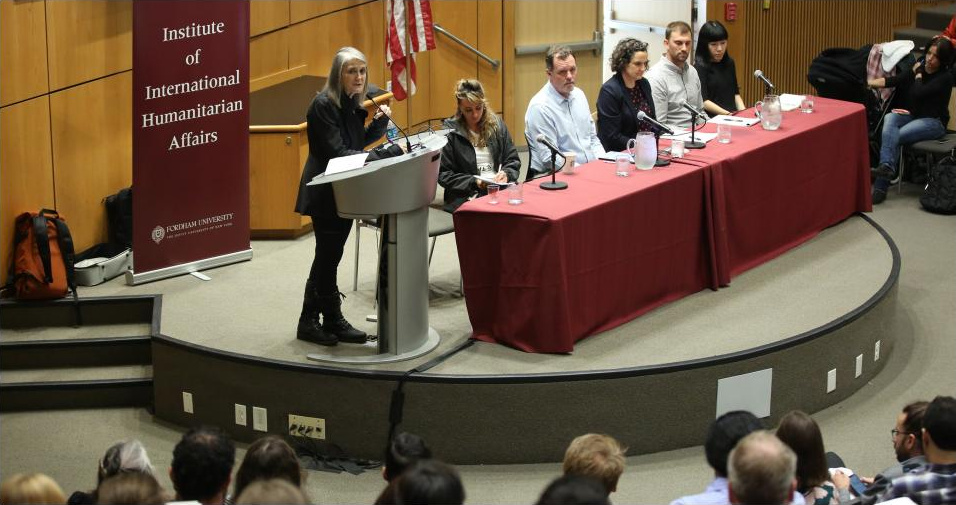
In April of 2016, the unofficial historian of the Standing Rock Sioux in North Dakota named LaDonna Brave Bull Allard opened her property along the Cannonball River to the "resistance." She thought a couple of dozen people would come to fight what she called the "black snake." This is, of course, the Dakota Access Pipeline, built by Energy Transfer Partners, that would take fracked oil from the Bakken Oil Fields of North Dakota through South Dakota, Iowa, Illinois, and hook up with a pipeline to the Gulf of Mexico. The indigenous Standing Rock Sioux said, "No." They weren't different from other North Dakotans, as the people of Bismarck, the capital of North Dakota, said "No," and the people of Mandan, where the courts and the prisons are, had said "No." These are the prisons where hundreds of indigenous people who were protesting the pipeline were imprisoned, but the people of Mandan themselves had said "No," and so ETP could not build the pipeline there. Instead, they were building it next to the Standing Rock Reservation.
They didn't call themselves "protestors," they called themselves "water protectors," because they were concerned that, going under the Missouri River, the longest river in North America, the pipeline would endanger the water supply of the 7 million people downstream. They see themselves as protectors of the planet for everyone, fighting for a sustainable future. They see themselves connected to the people of Sub-Saharan Africa who must leave their homes because of desertification. To the boy we had on Democracy Now, who had migrated to Durban, South Africa from the Maldives, and said, "my country is drowning." To the people of Sub-Saharan Africa who say, "you are cooking our continent." The indigenous people of this country say, "We're doing it for everyone so you can stay in your homes, and we can stay in ours."
This was the presidential election year in the United States, 2016, and media was almost completely ignoring this historic moment. Ladonna Brave Bull Allard opened her property for a couple of dozen people. Hundreds, then thousands came, from Latin American indigenous tribes to United States First Nations of Canada, to non-native allies. They opened up one resistance camp from Sacred Stone to Red Warrior Camp to other camps. Because the indigenous people saw it as a struggle for everyone, we felt it was critical to get their voices out. We went there on Labor Day Weekend. This was at the time when, in the Presidential Debates, not one of them—I won't call them journalists, maybe personalities— raised the issue of climate change. Climate change affects everyone, partly why you do the work you do, and why you have to do the work that you do. We went there Labor Day Weekend, and what we saw was indigenous men, women, boys, and girls holding glasses of water to give to the fully militarized police departments that would meet them with tanks, with MRAPS, with automatic weapons. These were their neighbors! Years before, when Michael Brown was killed, and the people rose up, the militarized police departments of St. Louis met them with full force. This is recycling in America today. You take the weapons from Iraq and Afghanistan, and you give them to the local police departments of the United States. This dynamic is being fought by many, including former police chiefs who say, "How do you think we're gonna see our neighbors if we're looking at them through the barrel of a gun?"
The next day, a group of native people went to where they were going to plant their traditional flags. This was an area they considered to be their sacred burial ground. They had told the judge who would be ruling on whether they could prevent the pipeline from going in this area, and the judge said, "If you believe that, give me a map, prove it to me." They complied, and the judge gave the map to Energy Transfer Partners, yet when the tribe got to the area, there were six Dakota Access Pipeline bulldozers already excavating the land. Though the judge would be ruling in a few days, the company had taken advantage of this moment, taken the map, pulled their bulldozers from other sites, and had begun to destroy the facts on the ground, excavating the area so that the issue would be a moot point by the time the judge ruled. They were furious. They came upon the property, and they stood in front of the bulldozers, the women and the girls against these Earth-crushing machines, massive machines - and we were filming all of this. In fact, we were the only ones there filming. We just never turned off the cameras, and the bulldozers slowly pulled back, one by one. They kept pulling back, and the people kept marching forward, now in the hundreds, and that's when the Dakota Access Pipeline guards unleashed dogs on the protestors. People were bitten, beaten, maced, and pepper-sprayed, but they prevailed at a ridiculously high price -for the land, they said, for the water. Finally, the guards took their dogs, the tractors moved on, the bulldozers got out of the way, and we had this incredible video, which we hosted online.
Now, I'm often invited on MSNBC or CNN, and I say, "Why aren't you doing more around climate catastrophe? The time to do it is when you give your weather reports, prove that these disparate conditions of drought and freezing cold and floods actually are connected. Why don't the meteorologists talk about this? That's what most people tune into." The hosts always say, "the executives of our network say people's eyes glaze over when you say, 'climate change.'" So, we posted online, and within 24 hours, there were 14 million views that showed the lie to the execs that would drool at getting that kind of popular response. We interviewed people like Winona LaDuke, who lives on the White Earth Reservation in Northern Minnesota, and she said to the governor, "You are not George Wallace. This is not Alabama in 1965. We are through." That Thursday, the governor called out the National Guard in anticipation of the judge's ruling, and quietly, though I didn't know it at the time, issued an arrest warrant for me. It may have had something to do with showing the pictures. The next day we did our show, just down the street from here, and then my colleague and I flew to Canada. Now, I wasn't fleeing, I was invited to the Toronto International Film Festival because they were doing a documentary on I. F. Stone, the great muckraking journalist who said to journalism students, "If you can remember two words, remember 'governments lie,' if you can remember three words, remember ‘all governments lie." That was the name of the documentary, and in it, they documented the news organizations who were following in his footsteps. Because they documented Democracy Now, we came out there to speak after. The next day, during my talk at the University of Toronto, hundreds of people came out, students and professors, and midway through, I got a text that said, 'You're under arrest.’ I do see it's a North Dakota number, so this is probably real. I also know that if there's an arrest warrant issued for you, you won't necessarily be immediately arrested, but if you have interaction with FBI, police, or Border Guards, that you'll be taken. Here I am in Canada, and I have to come home, so I just looked out on the crowd and said, "Could someone call me a cab?" I thought I would refrain from telling them of what I had just been alerted to, so I could just make it over the border. I went home to New York, where I learned the news of the warrant was true, but I didn't take it personally. This was a nationwide threat, telling journalists, "Do not come to North Dakota," so we knew we had to go back and call the authorities’ bluff. When we landed in Bismarck, they dropped the charges, announcing they would bring stronger charges of felony riot, as if I'm a one-woman-riot. I called my North Dakota lawyer, not that I had one before, and I said, "what does this mean?" and he said, "Maybe a year in jail." I said, "A year in jail? How much time do I have?" and he said, "Well, you'll be arraigned in two days," so I said, "Two more days to cover the protest.”
On that Monday morning, we did the broadcast from Mandan right outside the prison and the courthouse so I could just turn around and turn myself in. Well, it was the prison, the courthouse, and the Ten Commandments in between. I interviewed the chairman of the Standing Rock Sioux, the 45th chairman named Dave Archambault, and I asked if he had been arrested, and he said, "yes, at the beginning of this, for civil disobedience, a low-level misdemeanor." I asked, "what happened to you?" and he said, "Oh, I was put in an orange jumpsuit, and I was jailed, strip-searched." I interviewed Dr. Sarah Jumping Eagle, the pediatrician of the Standing Rock Reservation, and I said, "Were you ever arrested?" She was among the first since she's the most concerned about the kids' health, she said, "Oh yes, I was arrested on a low-level misdemeanor, and I was strip-searched, put in an orange jumpsuit and I was jailed." I mean, how much humiliation can people take? At the end of the broadcast, we were heading across the street, and hundreds of Native Americans came to show their solidarity, and this time, all the media was covering this because a journalist was about to be arrested. It was the homepage of the BBC and Aljazeera and the New York Times, Los Angeles Times, and even Vogue Magazine was covering this. As I was going across the street, we were told that the judge would not even sign off on the charges against me. And it was not only me. The Native Americans who were facing court that day had their felonies and misdemeanors dropped. This is what happens when the media shines a light in the right direction. This is the kind of reality TV we have to support. This is why we need independent media.
I want to end with the story, this historical story, as this week, we saw in Congress a hearing on reparations in the United States around slavery. Ta-Nehesi Coates, the great writer, testifying for the first time before the House Judiciary Committee. I wanted to leave you with this story of 1955: The story of Emmet Till, and why the images matter. The 14-year-old African-American boy lived in Chicago, and his mother, Mamie, wanted him out of the city for the summer, sent him to Money, Mississippi, and there he lived with his aunt and uncle and cousins. As he's sleeping one night, a white mob comes and rips him out of bed, and he ends up on the bottom of the Tallahatchie River. They said he wolf-whistled at a white woman. He was tortured, and he was killed. When his body was dredged up and sent back to Chicago, his mother, Mamie Till, did something incredibly brave. She said she wanted the casket open for the wake and the funeral. She wanted the world to see the ravages of racism, the brutality of bigotry.
Jet Magazine and other black publications took photographs of his distended, mutilated head, and they were actually published. With that, they were seared into the history and consciousness of this country. Mamie Till had something important to teach the media of today. Show the pictures. Show the images. Could you imagine if even for just one week, the media showed the images of war, of refugees attempting to find safety, showed the images of climate devastation? If the top of every radio and TV newscast was the story of a child who died in Afghanistan, and we actually learned her name and who her parents were? If the top, above the fold, of every surviving newspaper, was a woman in Syria trying to make her way to safety, and we actually learned her name because names are just as important as letting people tell their own stories? If every tweet, every email, talked about a soldier dead or dying?
Americans are a compassionate people. They would say no: war is not an answer to conflict in the 21st century. Democracy Now.
Source & original pages
Transcribed for the web and checked against the original yearbook pages. Line wrapping and page layout have been adapted for screen reading; the authors’ wording is retained. Roles, references and descriptions are those of the original publication.
- Page 37 contains an incomplete printed sentence ending “for trying to help an immigrant get out of the”. It is retained without adding guessed words. Historical names and wording, including “Klu Klux Klan”, “Ta-Nehesi Coates” and “Emmet Till”, are retained as printed.
- Original printed page 33
- Original printed page 34
- Original printed page 35
- Original printed page 36
- Original printed page 37
- Original printed page 38
- Original printed page 39
- Original printed page 40
- Original printed page 41
View the original page layouts