2019 / article
Social Fractures/Social Structures
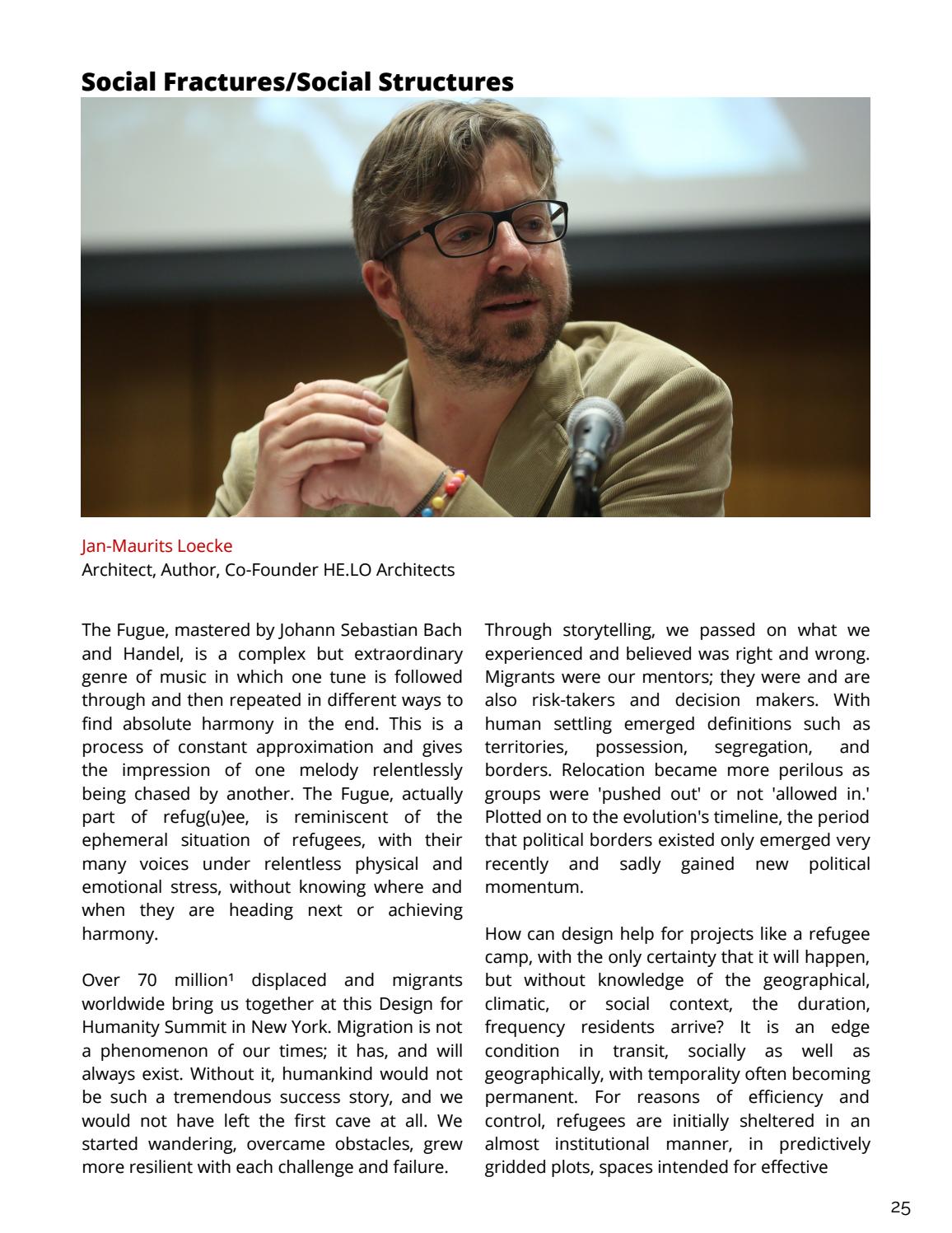
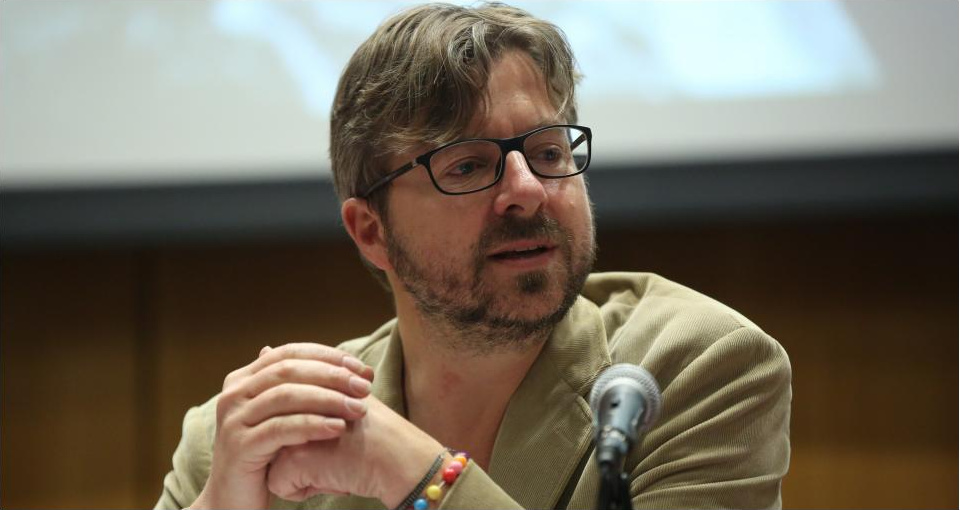
Architect, Author, Co-Founder HE.LO Architects
The Fugue, mastered by Johann Sebastian Bach and Handel, is a complex but extraordinary genre of music in which one tune is followed through and then repeated in different ways to find absolute harmony in the end. This is a process of constant approximation and gives the impression of one melody relentlessly being chased by another. The Fugue, actually part of refug(u)ee, is reminiscent of the ephemeral situation of refugees, with their many voices under relentless physical and emotional stress, without knowing where and when they are heading next or achieving harmony.
Over 70 million¹ displaced and migrants worldwide bring us together at this Design for Humanity Summit in New York. Migration is not a phenomenon of our times; it has, and will always exist. Without it, humankind would not be such a tremendous success story, and we would not have left the first cave at all. We started wandering, overcame obstacles, grew more resilient with each challenge and failure.
Through storytelling, we passed on what we experienced and believed was right and wrong. Migrants were our mentors; they were and are also risk-takers and decision makers. With human settling emerged definitions such as territories, possession, segregation, and borders. Relocation became more perilous as groups were 'pushed out' or not 'allowed in.' Plotted on to the evolution's timeline, the period that political borders existed only emerged very recently and sadly gained new political momentum.
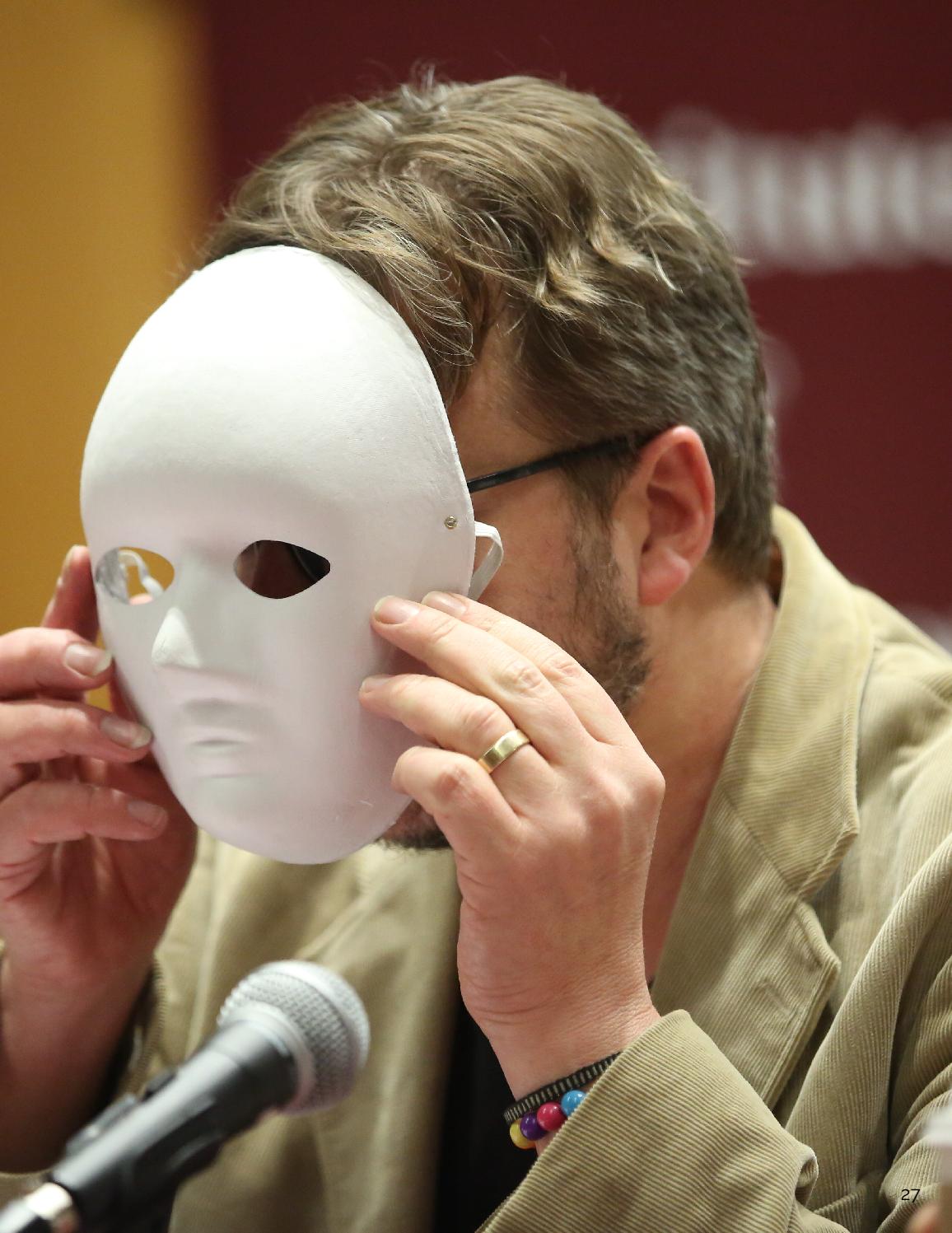
How can design help for projects like a refugee camp, with the only certainty that it will happen, but without knowledge of the geographical, climatic, or social context, the duration, frequency residents arrive? It is an edge condition in transit, socially as well as geographically, with temporality often becoming permanent. For reasons of efficiency and control, refugees are initially sheltered in an almost institutional manner, in predictively gridded plots, spaces intended for effective processing, stored without any space for individualism. Anonymity risks isolation, dysfunctionality, and dysconnectivity. To successfully help spaces become places, it is important to comprehend the meaning of home and identity. Breaking anonymity and unintended uniformity will create empowerment and caring communities, the basic of well-functioning neighborhoods.
He. Lo's spatial storytelling for Ceuta shows zones of self-organization and expression, adjacencies of denseness and openness, and follows the contours of society and geographical context.² Architecture and urban planning are synesthetic hybrids of many senses, contrasts, textures, odors, acoustics, light, and shadow as well as social aspects like wellbeing, curiosity, interpretation, and memories. One way to respond to social ruptures and fractures in our society is to create structures that are social and ethical. Being as participative as possible, they strengthen identity, heritage, positive memories, and social resilience. Functioning communities, as the most resilient cornerstones in societies, instigate care, education, joy, and acceptance. A well-balanced allowance for cultural infrastructures like community, nature, and gathering spaces, is needed to be added to the UNHCR Emergency Handbook³, a percentage for social cultural space to be added the 3-3.5m2 per person once immediate response stage is passed, as this is below parking lots in urban parking structures.
In a time where architecture and engineering have made leaps in terms of responsiveness through complex analytical tools, parametric processes, and digital manufacturing and concepts like biomimicry, buildings can be designed which were never possible before with an environmental and economic sustainable agenda. But foremost the social sustainability needs attention; one could say EnvironMENTAL gives a hint towards mental health. Building components under stress (in this case, heat or load) are endangered to break unless that stress is diverted, and the same goes for people. Social structures aim to ease stress.
Open and parallel structures converge along individuals’ paths for moments in time, often initiating an identity for remote places that are defined by temporality and unpredictability. . Like socially successful cities do not try to predict the unpredictable or plan the unknown future, in this case it is important, that the structures and spaces allow social “accidents” and instigate unpredictability. This creates resilience, a sense of empowering civilness. I couldn't agree more with Alberto Preato and Angela Wells, the initiators of D4H, "Leaving no one behind meaning not only responding to communities in need but actively including them in the design of the projects and policies that govern their lives."
Systems of musical notation encourage the formation of participative collectives⁴. Spaces can learn from music how to connect, inspire, liberate, empower, and bridge lingual, cultural, or generational barriers. As I started with the Fugue, I conclude with reference to John Cage, who I met. He empowers the interpreter to refine the composition, challenge the authorship, while Cage himself, the originator, steps back. The wounds of people and places in such extreme stressful contexts of war, natural disasters, oppression, and injustice might result in anxiety, anger, and despair becoming a constant companion in a refugee's later life. These wounds want to be healed, and we see a chance in this ephemeral context that social structures and a renewed emphasis on participative social-cultural spaces help to create resilient communities and initiate optimism.
References
- UNHCR refugee trend report, Filippo Brandi
- MoMA “Insecurities, tracing Displacement and shelter,” Medium https://medium.com/insecurities/35-9176-n-5-3670-w
- 3-3.5m2 per person, UNHCR Emergencies Handbook, pp 215-227
- Spacial Murmuring, “migration and spaces of ideas,” Henriques, Loecke, Papdakis 2013
Source & original pages
Transcribed for the web and checked against the original yearbook pages. Line wrapping and page layout have been adapted for screen reading; the authors’ wording is retained. Roles, references and descriptions are those of the original publication.
- Footnote markers are rendered as superscript numerals; footnote text is transcribed from the bottom of page 26.
View the original page layouts