2019 / address
Opening Remarks
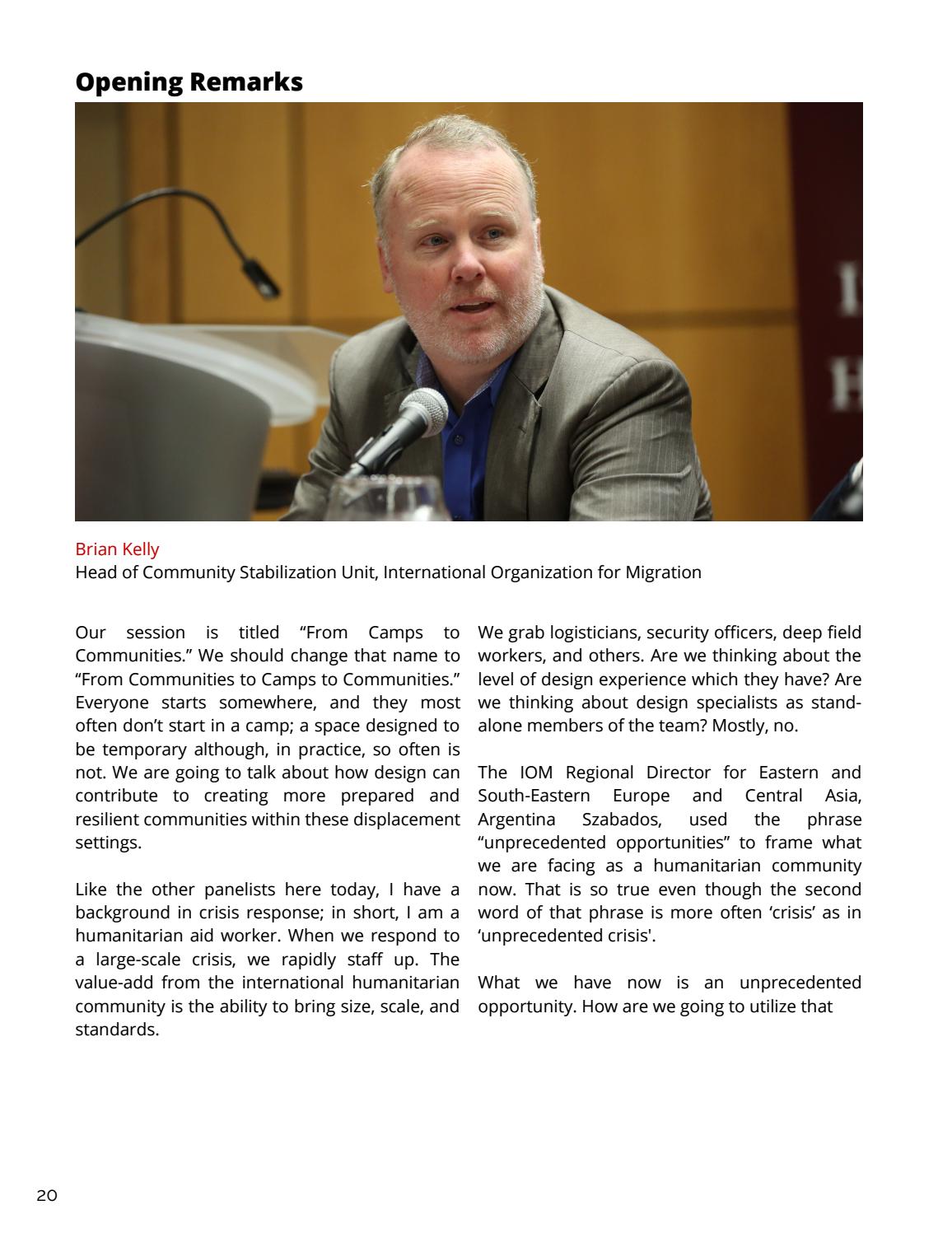
Head of Community Stabilization Unit, International Organization for Migration
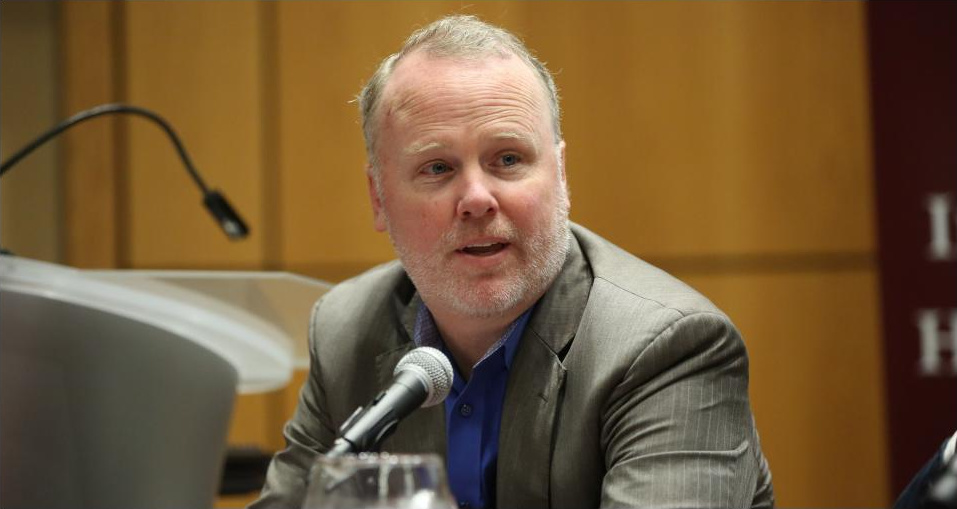
Our session is titled “From Camps to Communities.” We should change that name to “From Communities to Camps to Communities.” Everyone starts somewhere, and they most often don't start in a camp; a space designed to be temporary although, in practice, so often is not. We are going to talk about how design can contribute to creating more prepared and resilient communities within these displacement settings.
Like the other panelists here today, I have a background in crisis response; in short, I am a humanitarian aid worker. When we respond to a large-scale crisis, we rapidly staff up. The value-add from the international humanitarian community is the ability to bring size, scale, and standards.
We grab logisticians, security officers, deep field workers, and others. Are we thinking about the level of design experience which they have? Are we thinking about design specialists as stand-alone members of the team? Mostly, no.
The IOM Regional Director for Eastern and South-Eastern Europe and Central Asia, Argentina Szabados, used the phrase “unprecedented opportunities” to frame what we are facing as a humanitarian community now. That is so true even though the second word of that phrase is more often ‘crisis’ as in ‘unprecedented crisis’.
What we have now is an unprecedented opportunity. How are we going to utilize that opportunity? How do we make sure that we get design thinking integrated within a response while ensuring that people affected by the response are at the center of it? Unfortunately, we have a lot of opportunities to try this. If we go from West Africa, dealing with Boko Haram, to Central Africa with the Ebola crisis, to East Africa with conflict in Somalia and large outflows from Ethiopia, across the Red Sea to Yemen, and of course, we have Iraq and Syria. We could keep on moving east and talk about the Rohingyas in Bangladesh and Myanmar, a lot of displacement through conflict still in the Southern Philippines, and we haven't even gotten to Venezuela yet. Unfortunately, we are presented with a huge opportunity to practice our trade. We have such an immense obligation to do it and to do it well.
For 2018, as Brendan mentioned in his introduction, over 70 million people were displaced, double the figure from 20 years ago. 61% are now based in urban areas, which is another shift. Two-thirds of all of them are displaced for more than five years. So, can we really use the word “temporary”? We design for temporary, we want temporary, but 1 in 5 situations lasts more than 20 years. That is not temporary; that is a generation. I often talk to governments about alternatives to camps because camps are horrific places, and this is coming from an individual representing the global cluster lead on camp coordination and camp management. They create dependency, and they create significant issues relating to sexual violence against women. There are all sorts of negative impacts on the environment and elsewhere with camps. While camps are very easy to open - they are very, very hard to close.
Source & original pages
Transcribed for the web and checked against the original yearbook pages. Line wrapping and page layout have been adapted for screen reading; the authors’ wording is retained. Roles, references and descriptions are those of the original publication.
View the original page layouts