2019 / workshop
Mapping Home and Hope: Using Mapping Tools to Better Understand the Place Experiences of Displaced Refugee Families
Bree Akesson — Associate Professor, Wilfrid Laurier University’s Faculty of Social Work
Kearny Coupland — Ph.D. Candidate in the Geography Department at Wilfrid Laurier University
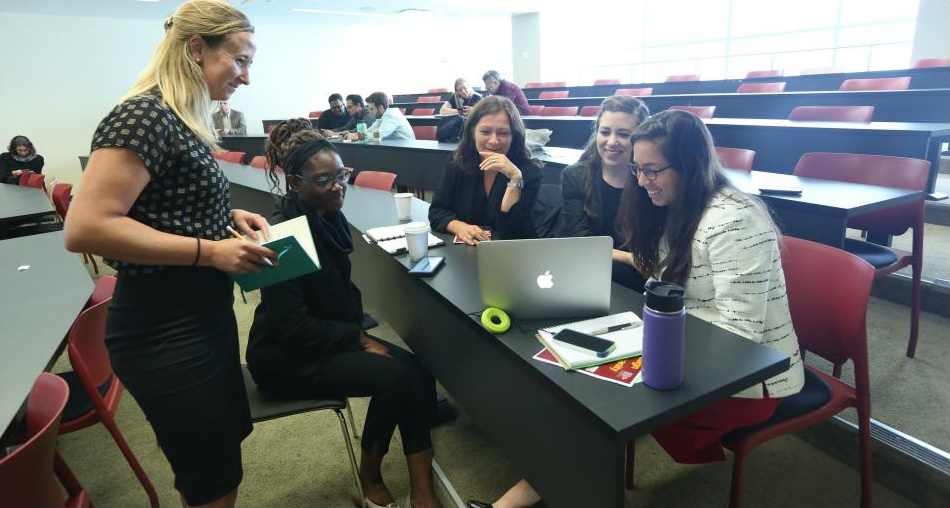
Over the past several years, there have been increased numbers of people fleeing war and violence in their home countries. With the sudden arrival of large numbers of refugees in poor resource settings, sites for living, working, and learning have developed rapidly without attention to the social and spatial implications. Focusing on the experiences of Syrian families living in Lebanon, our research examines how the everyday mobilities of children and families are affected by displacement and describe the multiple interrelated factors that contribute to (im)mobility. Our research team used a unique methodology engaging participants in collaborative family interviews with drawing and mapmaking, GPS-tracked neighborhood walks, and daily diaries. In addition to capturing the socio-spatial experiences of Syrian families displaced in Lebanon, the research provided an opportunity for families to share the stories of their journey from life in Syria before the war, life in Syria after the war, their flight from Syria to Lebanon, life in Lebanon, and their hopes for the future. Forty-six Syrian families participated in the study, to identify their needs, hopes, and barriers to resources in their everyday lives. In addition to limited access to education, employment, and medical services, families discussed the emerging challenges related to limited mobility, including boredom, lack of socialization, depression, and changing family dynamics.
The results of these methods provided a story of the interviewed families' experiences in Lebanon illustrated by GPS maps, drawings, and photos. The stories aim to inform the development of effective programs and policies and serve as a basis from which to design spaces for community cohesion. This unique research not only provides an example of a research methodology that actively engages displaced populations but also finds opportunities to share the stories of these families through an interactive website. The site, outofplaceresearch.com, is dedicated to highlighting the resilience of the families that welcomed our research team into their homes and lives.
Source & original pages
Transcribed for the web and checked against the original yearbook pages. Line wrapping and page layout have been adapted for screen reading; the authors’ wording is retained. Roles, references and descriptions are those of the original publication.
- The article byline spells the second author “Kearny Coupland”; the programme spells the name “Kearney Coupland”. The article byline is retained.
View the original page layouts