2019 / article
Ecology of Humanitarian Tale
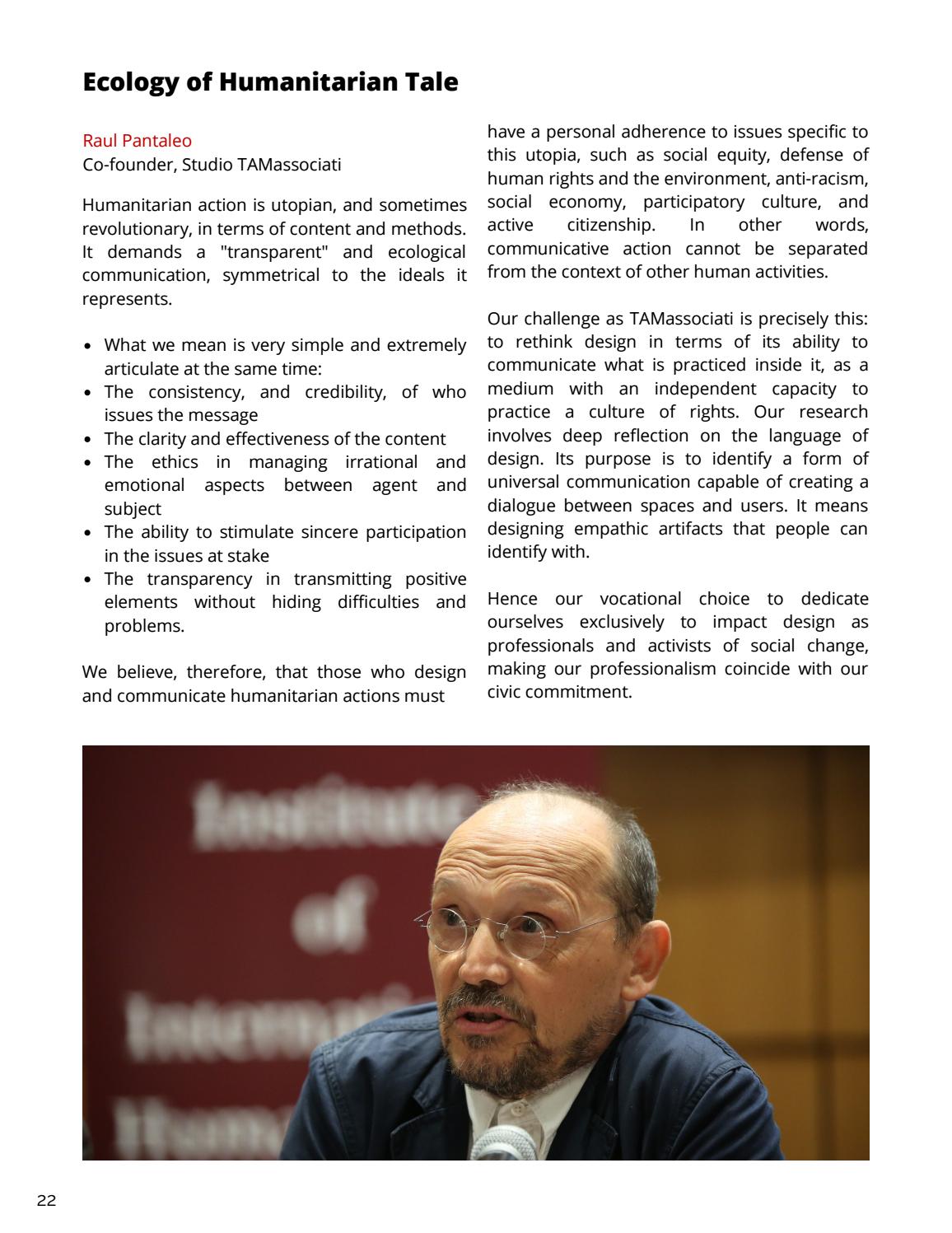
Co-founder, Studio TAMassociati
Humanitarian action is utopian, and sometimes revolutionary, in terms of content and methods. It demands a "transparent" and ecological communication, symmetrical to the ideals it represents.
- What we mean is very simple and extremely articulate at the same time:
- The consistency, and credibility, of who issues the message
- The clarity and effectiveness of the content
- The ethics in managing irrational and emotional aspects between agent and subject
- The ability to stimulate sincere participation in the issues at stake
- The transparency in transmitting positive elements without hiding difficulties and problems.
We believe, therefore, that those who design and communicate humanitarian actions must have a personal adherence to issues specific to this utopia, such as social equity, defense of human rights and the environment, anti-racism, social economy, participatory culture, and active citizenship. In other words, communicative action cannot be separated from the context of other human activities.
Our challenge as TAMassociati is precisely this: to rethink design in terms of its ability to communicate what is practiced inside it, as a medium with an independent capacity to practice a culture of rights. Our research involves deep reflection on the language of design. Its purpose is to identify a form of universal communication capable of creating a dialogue between spaces and users. It means designing empathic artifacts that people can identify with.
Hence our vocational choice to dedicate ourselves exclusively to impact design as professionals and activists of social change, making our professionalism coincide with our civic commitment.
Source & original pages
Transcribed for the web and checked against the original yearbook pages. Line wrapping and page layout have been adapted for screen reading; the authors’ wording is retained. Roles, references and descriptions are those of the original publication.
View the original page layouts