2019 / address
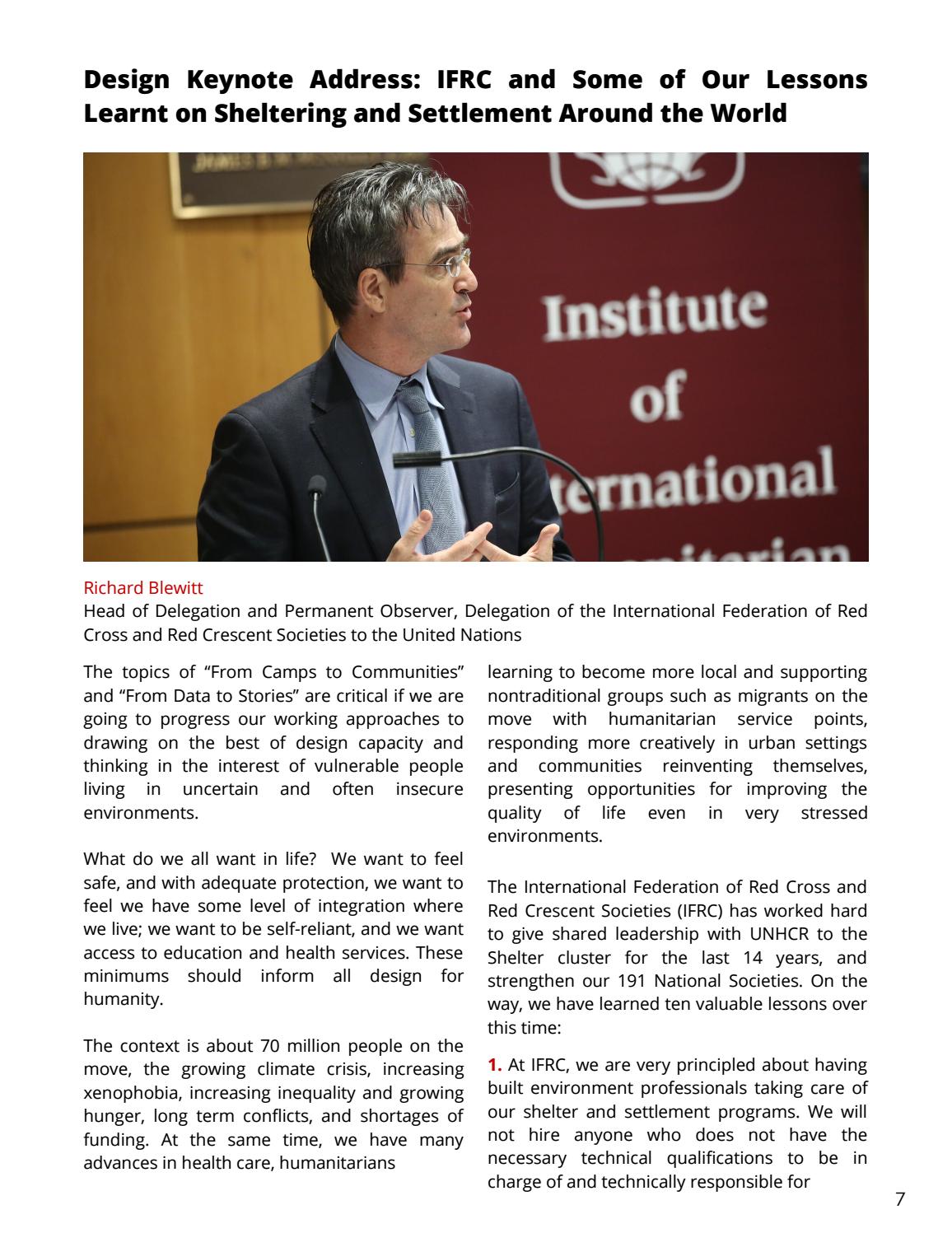
Design Keynote Address: IFRC and Some of Our Lessons Learnt on Sheltering and Settlement Around the World
Head of Delegation and Permanent Observer, Delegation of the International Federation of Red Cross and Red Crescent Societies to the United Nations
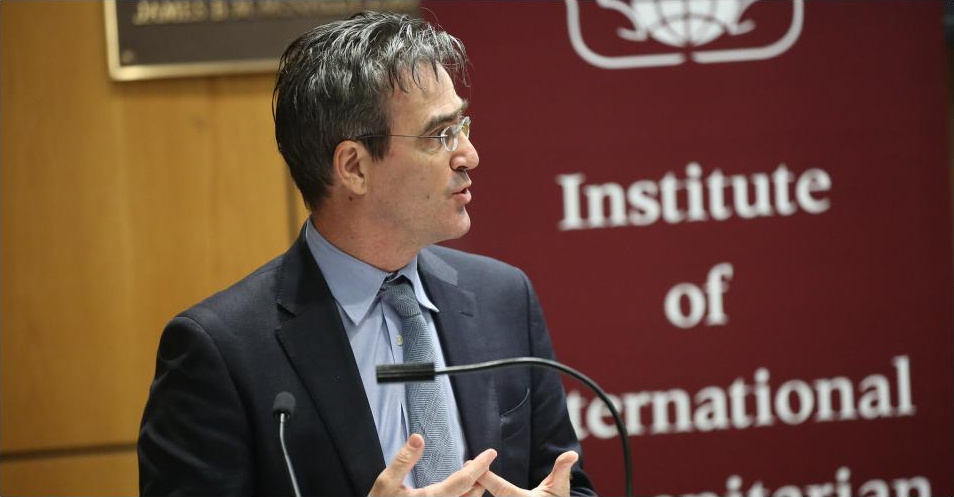
The topics of “From Camps to Communities” and “From Data to Stories” are critical if we are going to progress our working approaches to drawing on the best of design capacity and thinking in the interest of vulnerable people living in uncertain and often insecure environments.
What do we all want in life? We want to feel safe, and with adequate protection, we want to feel we have some level of integration where we live; we want to be self-reliant, and we want access to education and health services. These minimums should inform all design for humanity.
The context is about 70 million people on the move, the growing climate crisis, increasing xenophobia, increasing inequality and growing hunger, long term conflicts, and shortages of funding. At the same time, we have many advances in health care, humanitarians learning to become more local and supporting nontraditional groups such as migrants on the move with humanitarian service points, responding more creatively in urban settings and communities reinventing themselves, presenting opportunities for improving the quality of life even in very stressed environments.
The International Federation of Red Cross and Red Crescent Societies (IFRC) has worked hard to give shared leadership with UNHCR to the Shelter cluster for the last 14 years, and strengthen our 191 National Societies. On the way, we have learned ten valuable lessons over this time:
- At IFRC, we are very principled about having built environment professionals taking care of our shelter and settlement programs. We will not hire anyone who does not have the necessary technical qualifications to be in charge of and technically responsible for shelter programs. This is not only because of liability concerns but because the thinking that comes with built environment branches is very beneficial for sheltering strategies and process. As a result, we are also keen to have built environment professionals thinking about our line of work and getting more involved (both coming from practice and academia).
- Our approach to shelter and settlements programming favors the “process approach” above a “product approach.” The process approach focuses on supporting the affected people to achieve their priorities and preferences when it comes to their home rather than providing them with “products” that will, in many cases, be closed solutions that do not lend themselves to modification or incremental expansion/extension and are not in line with people's preferences. This position, of course, needs to be nuanced because there are times when giving items or products is the best sheltering option for the situation at hand (e.g., conflict or large-scale population movements where people move to an area where there is no other option - no host families, no existing housing stock, etc.).
- We need to use design processes and thinking to incrementally improve and innovate on the local building practices to achieve safe sheltering options for the people. We need to understand and analyze the priorities and preferences of the people, as well as the local building practices, and try to introduce technically achievable improvements to manage future risks they face.
- Disasters can provide us with elusive windows of opportunities to better plan communities or to improve their building practices. We need to take advantage of this by providing the appropriate technical support at the proper time in the most appropriate manner. We need to work on this in the long-term and with a locally driven mindset.
- The issue of funding is two-fold: first of all, shelter remains the lowest funded of all humanitarian sectors, and most of the funding we receive goes to emergencies in the form of household items. There is little money left over to think about recovery and self-recovery. Most donors have the perception that shelter is expensive as they think of houses and don't grasp the fact that there are many other ways of supporting the sheltering process of people, and not all are expensive. Secondly, tackling the challenges that stem from long-term issues such as climate change, urbanization, or underlying vulnerabilities require a long-term perspective on all fronts, including the funding. It is not the same to get one-year funding five times and to get a single 5-year funding. The humanitarian and development agendas need to tackle some of the issues (at least the ones related to settlements) together or at least through an aligned approach. However, we are far from that.
- Building back better and climate-smart is a good mantra, but often funding realities can get in the way. My recent United Nations Development Programme (UNDP) experience in Sint Maarten was painful. To build back hurricane five resilient roofs for at-risk groups cost 12,000 USD per roof (in line with the Governments standards), but the donor supporting the operation only wanted to pay 2,000 USD.
- We need to pay attention to those left behind. Last year IFRCs World Disasters Report focused on leaving no one behind. This looked at humanitarians needing to get better at reaching people out of scope, out of reach and out of sight.
- Maybe one of the biggest threats that the world is facing is the loss of experiences from elders. Perhaps design and sheltering innovation should also look to this, recording & reviving this knowledge and balance it with developing new innovations.
- We must always work with a moral/ethic value of what is built to promote humanitarian principles - dignity, safety, equality, social inclusion, respect of culture, and values.
- We need to try and work with community-based planning, enabling bottom-up initiatives, embracing change management, being pragmatic, increasing equity, and working to be gender-balanced.
Now I would like to share some perspectives from one of our experienced shelter specialists, Xavier, who has spent the last 15 years working on shelter and is currently in the Pacific. When addressing shelter needs of people in the Pacific we:
- Focus on the process and, in particular, the sheltering process, that people were following before a disaster, and the process to respond to their needs.
- We look at the emergency response but also at enabling factors to contribute to the households and community self-recovery.
- We focus on replicability, in the sense that often, the humanitarian response is serving only a tiny proportion of the needs on the ground. Replication is not about the capacity for people to replicate by buying material to reproduce the same. It is about being culturally appropriate, economically fitting, easily understandable, and with proper guidance.
Xavier highlights four experiences to support reflection in the shelter planning process:
- In Afghanistan, people used raw bricks as the primary construction material. The innovation brought here was to disseminate the "cooked brick" technology, but sadly the result was massive deforestation. Avoiding unintended negative impacts is critical to a thoughtful sheltering strategy. This is not an isolated example and is also not specific to one agency. It happens quite a lot that people don't think beyond their project's timeframe and location. IFRC is trying to address this through the Green Response initiative.
- In the Pacific, when a community chief in Tanna (an island in Vanuatu that was impacted by Cyclone PAM in 2015) was asked about the significant challenge that his community was facing with housing, he replied, "the introduction of western materials." We need to understand local building practices, improve them, or innovate around them rather than introducing imported technologies. This point is the key to ownership, as well as the durability and sustainability of your intervention.
- Then globally, "the tarpaulin." The tarpaulin is the fruit of extensive research with a lot of stakeholders from humanitarian and industrial stakeholders. For a relatively low cost, it's one of the main items used for humanitarian response worldwide. It's versatile, helping a lot of people to contribute to their sheltering process. This simple 4x6 piece of evolved plastic sheeting has two sides. One is light grey color, and the other one is dark grey with reinforced black lines to support fixing. How many people know that only one side is treated to resist the sun's impact? We must provide this information through awareness with distribution; otherwise, people might use it in the wrong sense, reducing its lifespan considerably. The tarpaulin can get used for other purposes, for instance, as a cholera bed; are we analyzing the impact of innovation on chemical treatment to lengthen the lifespan of tarpaulins, when skin is exposed to this directly? Are we sufficiently analyzing the potential negative collateral risks of our innovations?
Xavier was involved at the European Organization for Nuclear Research (CERN) in Switzerland in a hackathon with great thinkers from all over the world; they were given 48 hours to "hack" and develop a project. Here the question was innovation for humanitarian shelter for people on the move in Europe. Predictably for Xavier, their first approach was to explore 3D printer technology to develop a brand new way to produce shelters after disasters. Xavier engaged them on the sheltering process, on replicability at scale, cultural appropriateness, and they came up with a simple signpost: "I'm a citizen, and I have a room to spare" to "I'm a person on a move who needs a room for tonight."
I hope these few words with a focus on lessons learned and examples connect with you and give food for thought for the day ahead. Good luck
Source & original pages
Transcribed for the web and checked against the original yearbook pages. Line wrapping and page layout have been adapted for screen reading; the authors’ wording is retained. Roles, references and descriptions are those of the original publication.
View the original page layouts