2019 / article
Design-Based Thinking
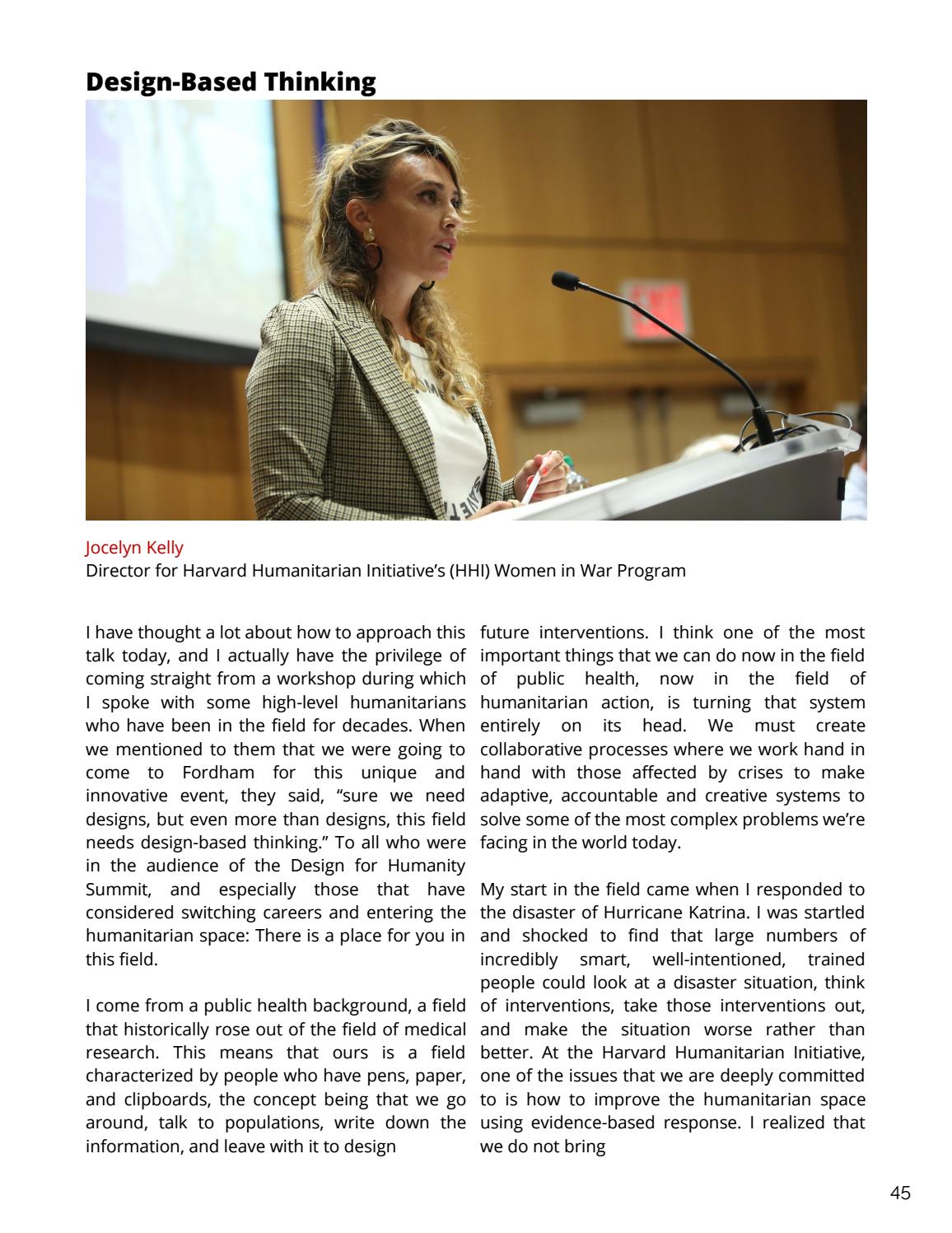
Director for Harvard Humanitarian Initiative’s (HHI) Women in War Program
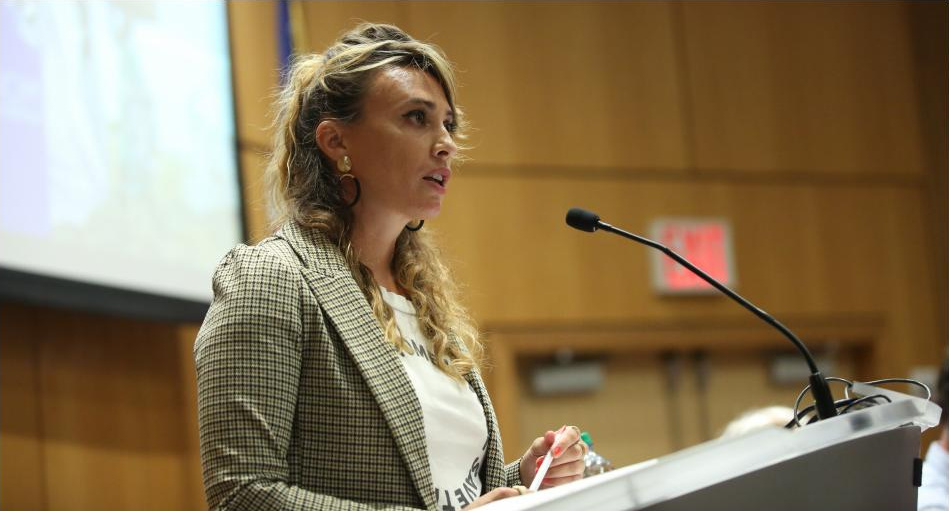
I have thought a lot about how to approach this talk today, and I actually have the privilege of coming straight from a workshop during which I spoke with some high-level humanitarians who have been in the field for decades. When we mentioned to them that we were going to come to Fordham for this unique and innovative event, they said, “sure we need designs, but even more than designs, this field needs design-based thinking.” To all who were in the audience of the Design for Humanity Summit, and especially those that have considered switching careers and entering the humanitarian space: There is a place for you in this field.
I come from a public health background, a field that historically rose out of the field of medical research. This means that ours is a field characterized by people who have pens, paper, and clipboards, the concept being that we go around, talk to populations, write down the information, and leave with it to design future interventions. I think one of the most important things that we can do now in the field of public health, now in the field of humanitarian action, is turning that system entirely on its head. We must create collaborative processes where we work hand in hand with those affected by crises to make adaptive, accountable and creative systems to solve some of the most complex problems we're facing in the world today.
My start in the field came when I responded to the disaster of Hurricane Katrina. I was startled and shocked to find that large numbers of incredibly smart, well-intentioned, trained people could look at a disaster situation, think of interventions, take those interventions out, and make the situation worse rather than better. At the Harvard Humanitarian Initiative, one of the issues that we are deeply committed to is how to improve the humanitarian space using evidence-based response. I realized that we do not bring enough science or evidence into how we help people in their most vulnerable moments, and this led me to pursue a Master's in Public Health and Human Rights. During that process, I got an internship in the Democratic Republic of the Congo. When I traveled there, I was set up to learn from a team of nurses who were responding to the epidemic of conflict-based sexual violence happening in the area. As someone who had been trained in human rights and public health, I immediately designed a survey, because that's what we had always been told to do. The nurses had been trying to figure out the underlying and resultant problems and how they could best address the unimaginable needs of these women who had been through conflict-related sexual violence. So, I created a survey, and as one does, it had very neat checkboxes so that you could theoretically get your clipboard out, tick the boxes, and determine the best solution to this problem.
The first day, the nurses went out with these surveys and began to conduct them. I felt that something was wrong. Something was not working, and we weren't doing the kind of research that we needed to do. The second day, they went back and tried to give the survey again, but this time I noticed there was a little bit of writing in the margins. By the third day, the checkboxes had been checked, but the nurses had written across the entire survey, telling the full narrative stories of these women. They felt that our human rights and public health checkboxes weren't doing justice to the stories that were emerging from this terrible violence. From that experience, I took away this idea that we need both qualitative and quantitative methods, both narrative and numbers, to really understand humanitarian action.
I want to tell you a little bit about one of my recent projects in the same area, the Eastern DRC, where I have worked for over 15 years with the same research firm. One of my favorite quotes is, “Poverty is having people read and write about you when you can't read and write yourself.” We were working with a locally-run NGO which had been tasked by the Congolese government to understand better how to mobilize, disarm, and reintegrate former child soldiers as well as all of the other vulnerable youth in these conflict-affected communities. They sought to find the most appropriate, meaningful ways to make the youth into co-collaborators rather than a research population, and how to undertake a meaningful research process with youth who had had been robbed of the opportunity to read and write. I think the answer is in the process and quality of the engagement rather than in the outcome. To undertake this very sensitive and challenging project, we decided to use participatory action research, which is rooted in liberation psychology by Paolo Fieri. We ended up throwing all of our preconceptions out the window, getting all the project partners that worked with vulnerable youth and organized a launch conference. We presented the group with a menu of research strategies that we had used at the Harvard Humanitarian Initiative and determined which of the strategies would be the most effective with our population. Together, we crafted research questions, designed the research methodology, and decided where we wanted the project to go. From that menu of methods, they decided on the traditional techniques of key informant interviews and focus groups, but also chose some newer, less conventional methods like Body Mapping and PhotoVoice: visual methods. The powerful thing about visual methods is that they allow populations to viscerally and directly interact with the data that they generate, whether or not they've had the opportunity to go to school.
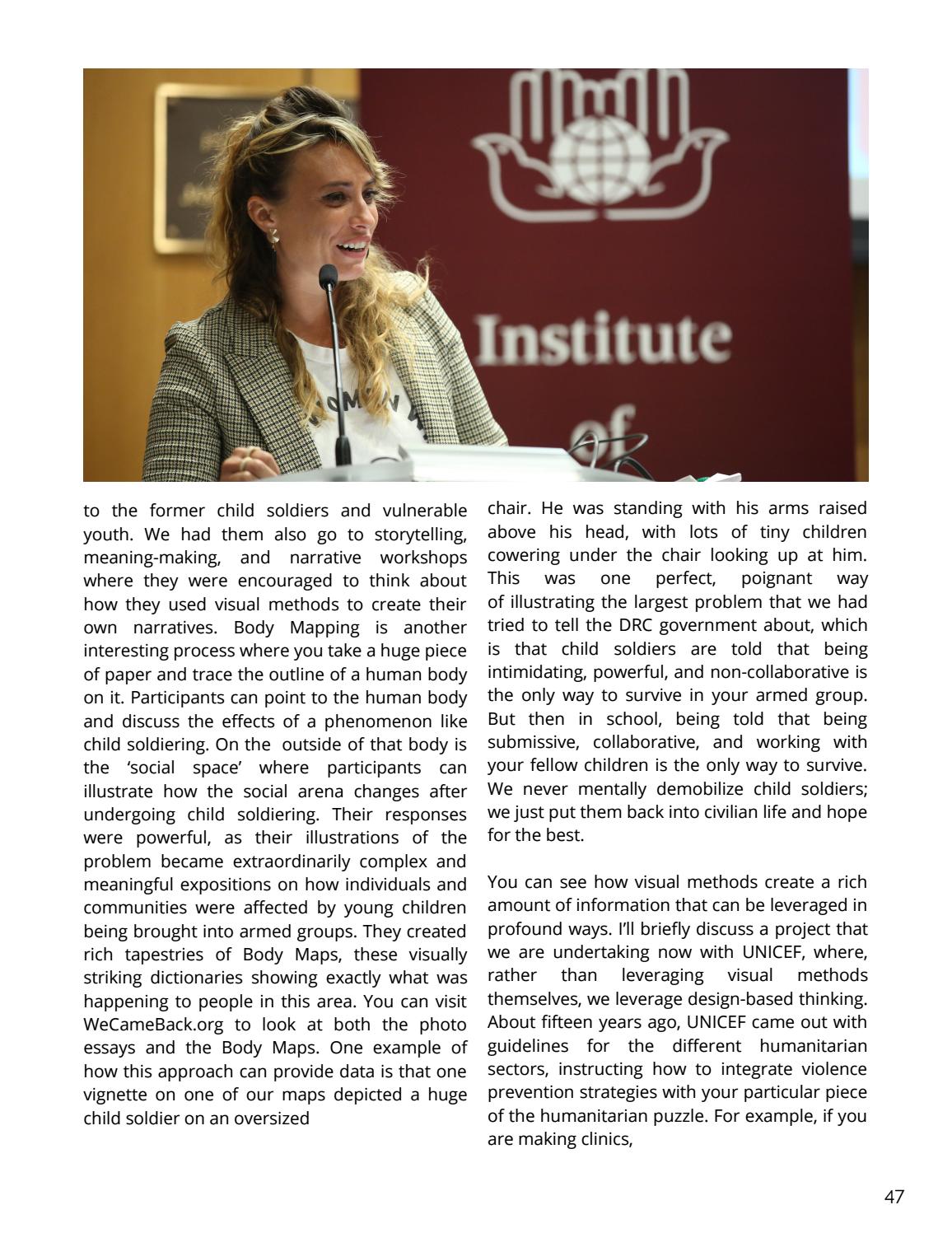
Through PhotoVoice, we distributed cameras to the former child soldiers and vulnerable youth. We had them also go to storytelling, meaning-making, and narrative workshops where they were encouraged to think about how they used visual methods to create their own narratives. Body Mapping is another interesting process where you take a huge piece of paper and trace the outline of a human body on it. Participants can point to the human body and discuss the effects of a phenomenon like child soldiering. On the outside of that body is the ‘social space’ where participants can illustrate how the social arena changes after undergoing child soldiering. Their responses were powerful, as their illustrations of the problem became extraordinarily complex and meaningful expositions on how individuals and communities were affected by young children being brought into armed groups. They created rich tapestries of Body Maps, these visually striking dictionaries showing exactly what was happening to people in this area. You can visit WeCameBack.org to look at both the photo essays and the Body Maps. One example of how this approach can provide data is that one vignette on one of our maps depicted a huge child soldier on an oversized chair. He was standing with his arms raised above his head, with lots of tiny children cowering under the chair looking up at him. This was one perfect, poignant way of illustrating the largest problem that we had tried to tell the DRC government about, which is that child soldiers are told that being intimidating, powerful, and non-collaborative is the only way to survive in your armed group. But then in school, being told that being submissive, collaborative, and working with your fellow children is the only way to survive. We never mentally demobilize child soldiers; we just put them back into civilian life and hope for the best.
You can see how visual methods create a rich amount of information that can be leveraged in profound ways. I'll briefly discuss a project that we are undertaking now with UNICEF, where, rather than leveraging visual methods themselves, we leverage design-based thinking. About fifteen years ago, UNICEF came out with guidelines for the different humanitarian sectors, instructing how to integrate violence prevention strategies with your particular piece of the humanitarian puzzle. For example, if you are making clinics, here were instructions on how to make clinics that support people in seeking healthcare without facing violence. If you are making latrines, here's how to design latrines without having men and women mix at night in a way that would expose women to the risk of violence. We have discussed with UNICEF, first of all, how to prevent violence with a higher success rate, but second, how to show that undertaking basic violence prevention makes the entire humanitarian response better, more effective, and safer for everyone involved. We have some great examples of how simple thought processes starting at the beginning of setting up a camp can change the entire outcome for the population involved. One classic example is that of a nutritional feeding center where starving babies were taken to get enriched therapeutic milk. The center was set up along a road that was being constructed, so you had large groups of male construction workers hanging out on this road while you had 15-year-old mothers and their babies crossing this gauntlet to get to the nutritional feeding center. I doubt I need to tell you this, but no babies got fatter in that camp. It was such a simple thing to take into account, and without considering these personal factors at the beginning of a process, it is impossible to get where you want to get in the humanitarian response. If we show that integrated violence prevention is not only better for women, but also for those babies who depend on that nutritional milk, only then can we get further in the humanitarian process.
In closing, I would say we need your design-oriented thinking. This is a plea to say: Let's not just improve the architecture of shelters, but let's improve the architecture of the humanitarian system as a whole. Let's not just improve the design of camps, but let's improve how we design around the dignity and empowerment of those in them.
Source & original pages
Transcribed for the web and checked against the original yearbook pages. Line wrapping and page layout have been adapted for screen reading; the authors’ wording is retained. Roles, references and descriptions are those of the original publication.
- The printed text attributes liberation psychology to “Paolo Fieri” and includes “had had been”; both are retained as printed.
View the original page layouts