2019 / article
Creating Hope in Conflict: A Humanitarian Grand Challenge
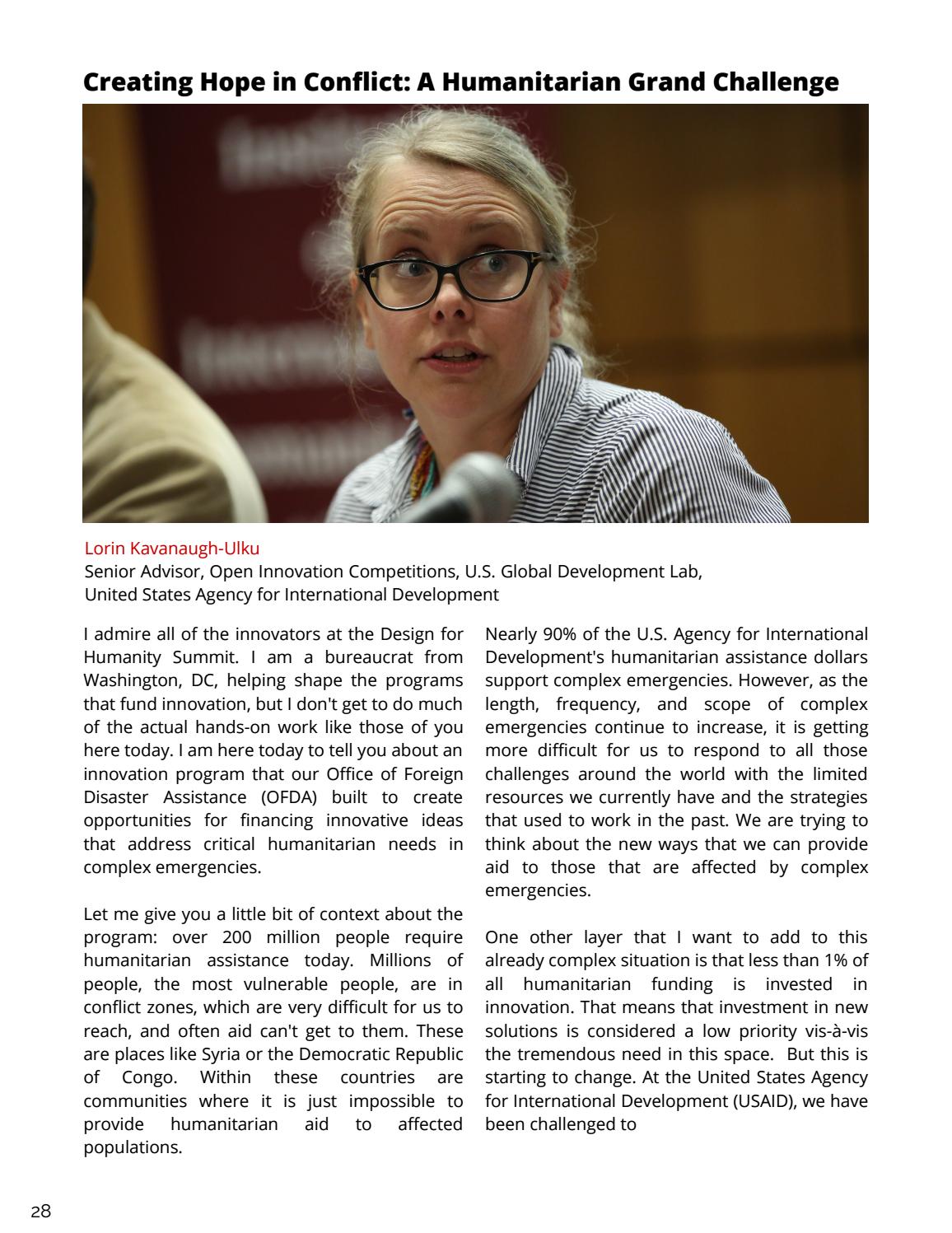
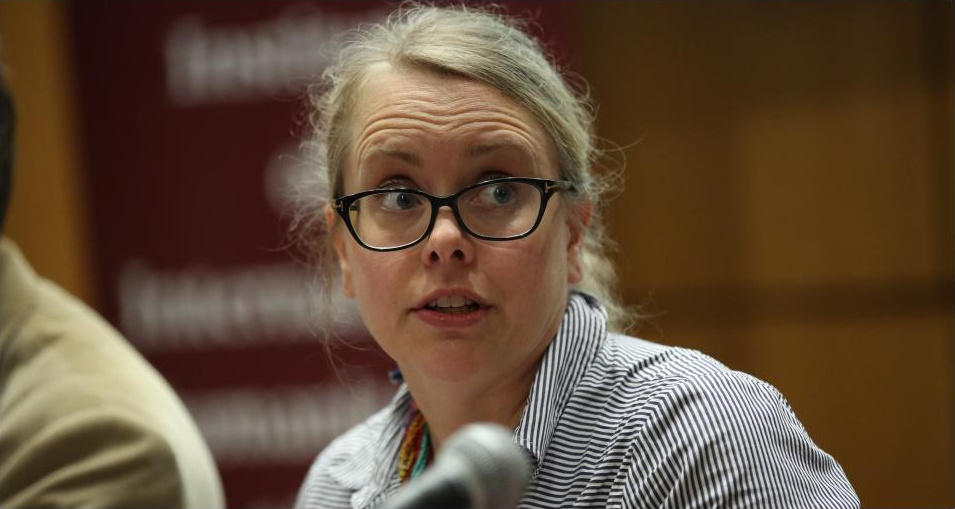
Senior Advisor, Open Innovation Competitions, U.S. Global Development Lab, United States Agency for International Development
I admire all of the innovators at the Design for Humanity Summit. I am a bureaucrat from Washington, DC, helping shape the programs that fund innovation, but I don't get to do much of the actual hands-on work like those of you here today. I am here today to tell you about an innovation program that our Office of Foreign Disaster Assistance (OFDA) built to create opportunities for financing innovative ideas that address critical humanitarian needs in complex emergencies.
Let me give you a little bit of context about the program: over 200 million people require humanitarian assistance today. Millions of people, the most vulnerable people, are in conflict zones, which are very difficult for us to reach, and often aid can't get to them. These are places like Syria or the Democratic Republic of Congo. Within these countries are communities where it is just impossible to provide humanitarian aid to affected populations.
Nearly 90% of the U.S. Agency for International Development's humanitarian assistance dollars support complex emergencies. However, as the length, frequency, and scope of complex emergencies continue to increase, it is getting more difficult for us to respond to all those challenges around the world with the limited resources we currently have and the strategies that used to work in the past. We are trying to think about the new ways that we can provide aid to those that are affected by complex emergencies.
One other layer that I want to add to this already complex situation is that less than 1% of all humanitarian funding is invested in innovation. That means that investment in new solutions is considered a low priority vis-a-vis the tremendous need in this space. But this is starting to change. At the United States Agency for International Development (USAID), we have been challenged to transform the way we deliver development and humanitarian assistance and update our strategies for addressing the world's most pressing problems.
That's where I come in. I lead the Open Innovation Competitions team in the U.S. Global Development Lab, which is essentially the innovation incubation center for the agency. It's where we are trying to test out new programs and design opportunities to see what works. On the innovation team, we work with user-centered design principles, adaptive management programming, and open innovation strategies such as prizes and challenges to invite new solvers to help respond to our most significant challenges. We fund the most promising ideas and solutions, test them, and scale up those that are successful.
Our goal is to help support teams like the Humanitarian Assistance team in OFDA, bring in new solvers, actors, potential partners and bring in new solutions that may help them become more effective and efficient with limited humanitarian assistance resources. To achieve this, we work hard to make USAID more permeable to actors who are traditionally not eligible for our awards. Typically, there are only a few firms around the world that are competitive enough to win a USAID proposal. Through open innovation, we are trying to change that completely to make it easier for anybody to access our procurement structures to open up open innovation competitions. That is one easy way that we are lowering the bar significantly to allow for better shelter designs to get into USAID and a more diverse group to start working with us on some of our programs.
How else can we bring in other solvers who have fantastic ideas? Well, we provide more dedicated funding! In 2018, the Office of Foreign Disaster Assistance recognized that the complex emergency space was ripe for new solutions from all around the world.
USAID's OFDA partnered with the UK. Department for International Development, the Netherlands Ministry of Foreign Affairs, and the implementing partner Grand Challenges Canada on the $32.5 million Creating Hope in Conflict: Humanitarian Grand Challenge. This partnership brings together these very important donor pairs who all agree that this is an issue that cannot be solved on its own. We needed to come together and invite the world to help share ideas for us to better support people in these complex emergencies, but we also wanted to find out how can we work with communities to develop those solutions.
Creating Hope in Conflict focuses on finding and accelerating solutions that enable life-saving or life-improving assistance in four sectors: safe water and sanitation, energy, life-saving information, health supplies, and services. In terms of the types of solutions the Challenge is looking for, the focus is not just on gadgets: process innovation is a critical part of this puzzle. We invite solvers to come up with new ways to deal with supply chain issues or to develop products in the communities using 3D printers or thinking about how telemedicine can help support medical interventions.
For the initial call for innovations, there was an unprecedented response with over 600 applications from 86 countries around the world. These applications dealt with a wide variety of issues from gender-based violence solutions helping women become more secure in a camp situation to smart toilets that helped reduce the need for removal of waste. The total request for funding far outstripped the total available funding, which means deciding on what to invest in is not easy. And now we have a new round for innovations. As we look to the future of this Challenge, we are hoping to bring in more donors and more private sector partners to build the funding path to ensure that there's more money for innovation in humanitarian space. We don't want to just fund solutions; we want to build an ecosystem around those solutions and ensure that innovators are not standing alone. We want them to be provided with mentors and other funders and investors that are around them that can help bring these ideas forward and make them sustainable for the future.
Source & original pages
Transcribed for the web and checked against the original yearbook pages. Line wrapping and page layout have been adapted for screen reading; the authors’ wording is retained. Roles, references and descriptions are those of the original publication.
View the original page layouts