2019 / workshop
Code of Ethics? Share Your Critical Reflections on Art and Design in the Humanitarian Context!
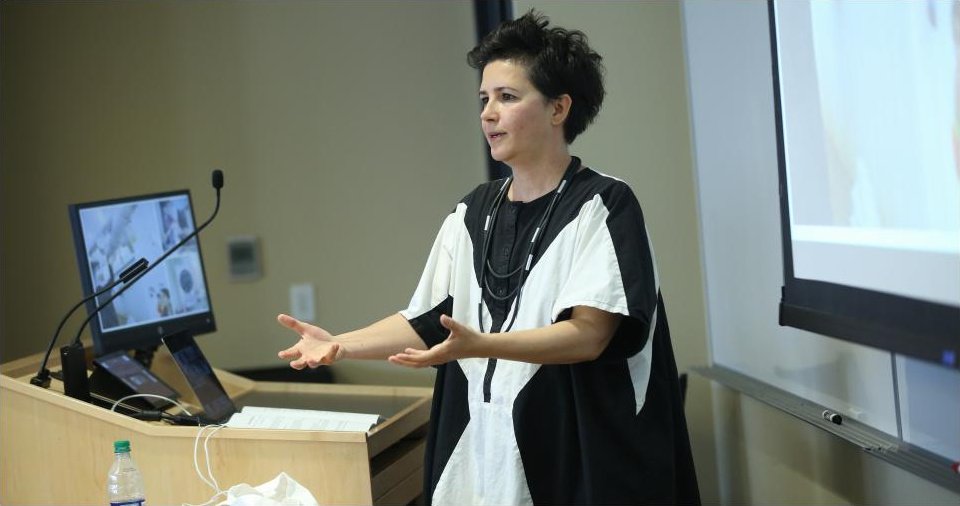
Director, MIT Future Heritage Lab (FHL) and Associate Professor, MIT Art, Culture and Technology Program
War, environmental disasters, and unequal distributions of wealth push fragile communities into conditions of scarcity. How can art and design practitioners support these communities, while steering away from savior mentalities? What tools and models can be learned from and developed through the socially engaged art and community-driven design that ethically address or reverse these conditions? It is impossible to be ethical always and in everything. Moreover, ethics differ vastly across cultures. What is possible, however, is having an honest consideration of ethics and their value in a rigorous practice.
This workshop Code of Ethics? explored ethics of cultural interventions in the humanitarian context. The Design for Humanity Summit II participants were invited to contribute to the international research and discussion Code of Ethics? platform from the perspective of their research or practical experience.
Run by the MIT Future Heritage Lab, the Code of Ethics? confronts cultural interventions in art, academia, and the humanitarian sphere with the refugees’ point of view, ethically problematizing the encounter, power relationships, and aesthetic versus social judgments regarding socially engaged art and design. The multitude of voices is disseminated online, not to prescribe a moral protocol, but to disrupt those in place through various critical viewpoints. Through the exchange of critical reflections, questions, and dilemmas, the platform aims to identify and raise awareness about important ethical concerns relevant to a wide range of actors operating in the humanitarian sector.
The workshop began with a presentation of the work conducted by the MIT Future Heritage Lab (FHL), a research and art lab at the Massachusetts Institute of Technology, Department of Architecture. Operating at the intersection of art and design, preservation of cultural heritage, and humanitarian relief, the FHL invents creative responses to conflict and crisis. The Lab's approach springs from the belief that culture is an essential human need. Since 2016, the FHL has been operating its satellite hub in the Al Azraq Refugee Camp in Jordan. Established in 2014, this was designed to become the region's largest camp, with a capacity to shelter 150,000 people. FHL has been collaborating with international museums and local Jordanian educational, cultural, and humanitarian aid institutions on activities and programs supporting the education of displaced Syrians and preservation of their living culture.
The second part of the workshop entailed a discussion about the ethics of art and design in the humanitarian context. Workshop participants were asked to respond to, critique, and/or replace one question selected from the list of concerns collected through the Code of Ethics? platform-FHL has collected these questions through workshops and events involving discussions with Syrian refugees, students in the USA, and Jordan, collaborating partners in various educational, cultural, and humanitarian organizations. These questions range from the ethics of encounter to power relationships between “humanitarians” and “beneficiaries,” to aesthetic versus social judgment of socially engaged art, among other concerns. The participants received bittersweet golden chocolate coins, indented with inscriptions “privilege” and “good intentions” on the one side, and “benefits” and “road to hell,” on the other side.
Code of Ethics? Questions On...
1. Needs
- How do I know that my creative work is addressing a “real” need?
- Are aesthetic and cultural needs necessary for the well-being of refugees? Is art/design/culture a basic or essential human need?
- Are refugees a “captive audience” for a project that I think is needed or I want to do?
2. Agency of Art, Culture, Design
- What is the role of art and design in the humanitarian context?
- What does it mean to “empower” refugees through design? How do I define authorship of projects that involve refugees?
- How do I document the created artworks/designs? Is it ethical to take pictures of refugees, if they are part of my/our project?
3. Education
- Where are my skills and knowledge best utilized?
- What can I learn from and teach to stateless people?
- How do I avoid perpetuating colonial power dynamics of knowledge exchange when working with threatened communities?
- Does my contribution to refugee education amount to educational certificates or degree programs? What is the benefit of a one-time workshop/course that I can offer, if this educational contribution is not part of a formal education program?
4. Cultural Preservation
- At the time of war and destruction, what is the role of cultural preservation? Is the preservation of threatened historical monuments more important than the preservation of refugees’ living culture?
- How is heritage preserved in an environment of cultural deprivation, such as a refugee camp?
5. Creative Process
- Do I design for or with refugees?
- How can I make use of my creative skills without taking the agency away from refugees?
- What is the role of collaborative processes? Are the process and the product of an intervention equally important?
- Are the expectations about the final result that I communicate with refugees realistic?
6. Economy
- Do refugees get paid for the collaboration with me? If yes, how is the project funding distributed?
- Is my contribution attuned to the limited resources of the humanitarian context? How can I contribute without burdening the humanitarian agencies?
- How do I fundraise for and promote my work with refugees?
- If I use funding for a good cause, does the source of funding matter?
- How is the economy of host countries affected by the influx of displaced people? Is the refugee crisis to be monetized?
7. Impact
- How many people are benefiting from my work?
- How do I measure/prove the impact of creative art/design/culture-based work? Does my work have a positive impact on the host population?
8. Intentions
- Is facilitating stateless people my moral obligation?
- Do I recognize the assumptions and biases I bring on the table?
- What motivates my work in the humanitarian context? Would I do this work without gaining any professional or social capital?
- Does my work in refugee camps imply that I advocate the existence of refugee camps? What are the power dynamics that my work with refugees entail?
Source & original pages
Transcribed for the web and checked against the original yearbook pages. Line wrapping and page layout have been adapted for screen reading; the authors’ wording is retained. Roles, references and descriptions are those of the original publication.
View the original page layouts