2018 / article
Three Ingredients to Emergency Response

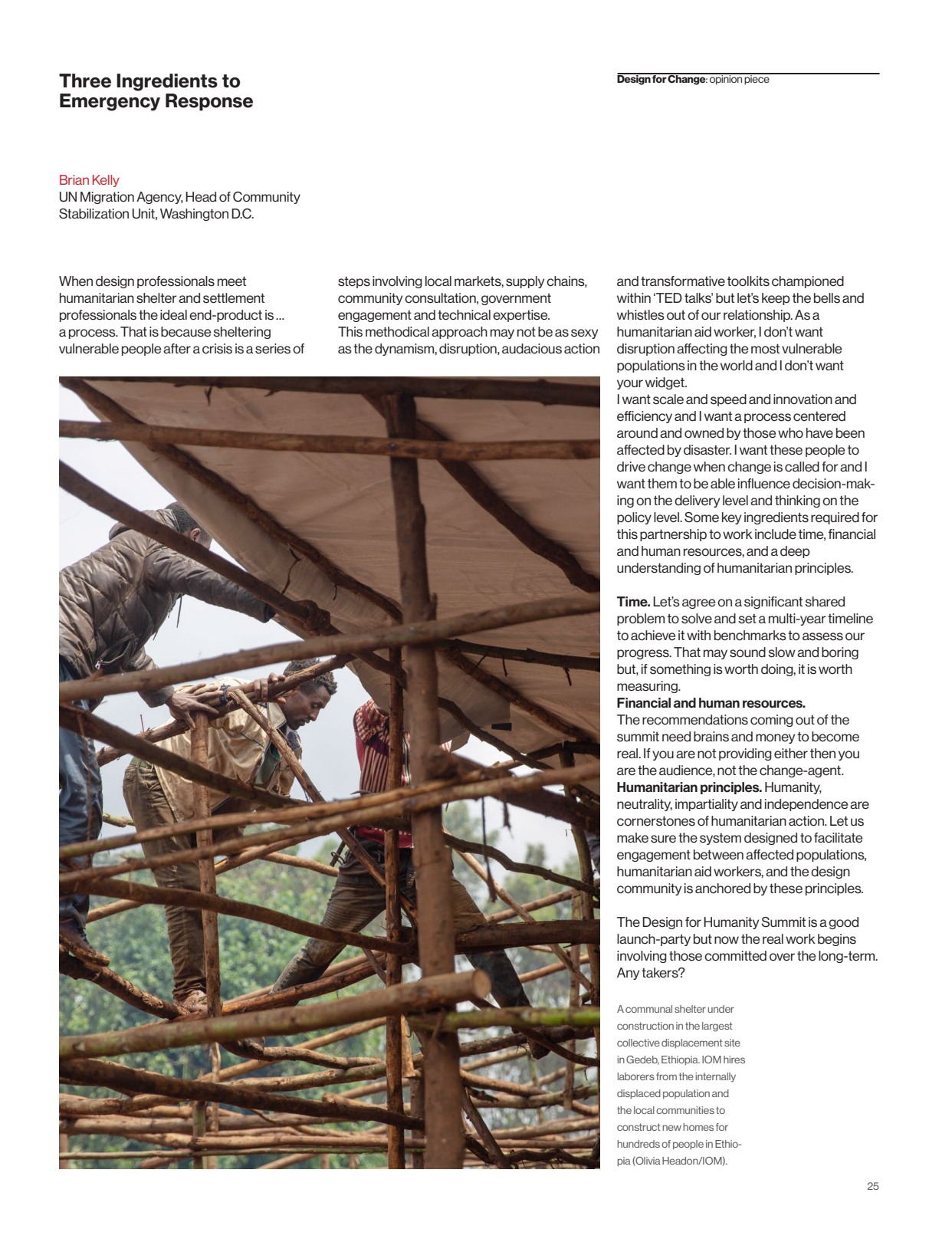
When design professionals meet humanitarian shelter and settlement professionals the ideal end-product is … a process. That is because sheltering vulnerable people after a crisis is a series of steps involving local markets, supply chains, community consultation, government engagement and technical expertise.
This methodical approach may not be as sexy as the dynamism, disruption, audacious action and transformative toolkits championed within ‘TED talks’ but let’s keep the bells and whistles out of our relationship. As a humanitarian aid worker, I don’t want disruption affecting the most vulnerable populations in the world and I don’t want your widget.
I want scale and speed and innovation and efficiency and I want a process centered around and owned by those who have been affected by disaster. I want these people to drive change when change is called for and I want them to be able influence decision-making on the delivery level and thinking on the policy level. Some key ingredients required for this partnership to work include time, financial and human resources, and a deep understanding of humanitarian principles.
Time.
Let’s agree on a significant shared problem to solve and set a multi-year timeline to achieve it with benchmarks to assess our progress. That may sound slow and boring but, if something is worth doing, it is worth measuring.
Financial and human resources.
The recommendations coming out of the summit need brains and money to become real. If you are not providing either then you are the audience, not the change-agent.
Humanitarian principles.
Humanity, neutrality, impartiality and independence are cornerstones of humanitarian action. Let us make sure the system designed to facilitate engagement between affected populations, humanitarian aid workers, and the design community is anchored by these principles.
The Design for Humanity Summit is a good launch-party but now the real work begins involving those committed over the long-term.
Any takers?
Source & original pages
Transcribed for the web and checked against the original yearbook pages. Line wrapping and page layout have been adapted for screen reading; the authors’ wording is retained. Roles, references and descriptions are those of the original publication.
View the original page layouts