2018 / interview
Spaces of Refuge: From Spaces of Exception to Places of Life
Angela: Why are you researching the effects of built environment on displaced communities?
Faten: The right to space is often conditional to the citizenship of a person or of a group of persons. Displaced populations often lack a legitimate institutional status, which deprives them from that right. But even if they are recognized as refugees, settlement policy frameworks adopted by host countries are often temporary and exclusionary. Thus, spaces they occupy are either assigned to them, in which case they are organized camps, or they settle informally in cities and in rural areas. These spaces are often excluded from urban systems.
In my research, I aim to understand the relation that displaced people develop with the spaces they occupy. Through the lens of space appropriation, I analyse the process through which refugees appropriate their living environment and transform it from a temporary “space” meant to shelter (a non-place), into a social “place” of life, culture, and identity.
My preliminary results show that refugee spaces evolve into a continuum that ranges between “spaces” and “places”. Results also show that, given displaced people’s deprivation of right to space, the process of space appropriation is affected by their level of power over their spaces. Power over space is in turn impacted by three main factors: First, hosting and settlement policy frameworks.
According to these policies, refugees can be more or less integrated in the public and legal systems. Their integration largely determines their institutional and socioeconomic capitals.
Second, the complex dynamics between various stakeholders involved in the management of displaced people and their spaces.
Stakeholders can be external to the refugee community such as the international community, the national and local governance body in the host state, and the humanitarian community. But they can also be part of the refugee community. In fact, despite being perceived as a homogeneous mass, refugees form a societal order based on a well-defined socioeconomic hierarchy. Third: the physical structure of the space on which its flexibility depends.
Angela: This issue of permanence is something that I think is pretty evident in every refugee situation. How would you approach, from a design point of view, this idea of temporary versus permanence?
Faten: The issue of permanence is, as you rightfully say, evident. In fact, according to the UNHCR, almost 70% of refugee situations become protracted and last in average 26 years. Despite this evidence, xenophobic misrepresentations of refugees as poor, dangerous, and invasive populations entail the implementation of exclusionary and temporary frameworks.
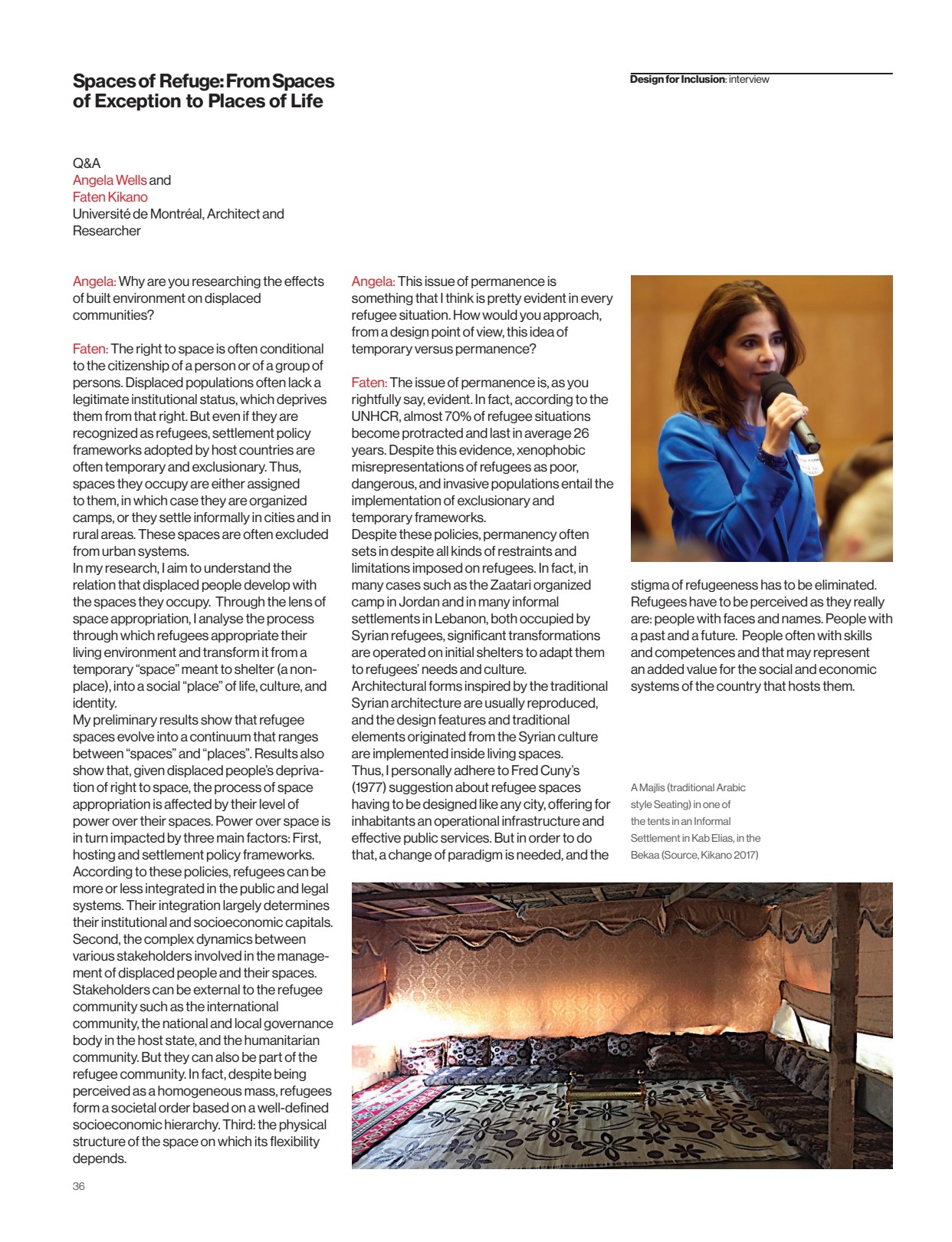
Despite these policies, permanency often sets in despite all kinds of restraints and limitations imposed on refugees. In fact, in many cases such as the Zaatari organized camp in Jordan and in many informal settlements in Lebanon, both occupied by Syrian refugees, significant transformations are operated on initial shelters to adapt them to refugees’ needs and culture.
Architectural forms inspired by the traditional Syrian architecture are usually reproduced, and the design features and traditional elements originated from the Syrian culture are implemented inside living spaces.
Thus, I personally adhere to Fred Cuny’s (1977) suggestion about refugee spaces having to be designed like any city, offering for inhabitants an operational infrastructure and effective public services. But in order to do that, a change of paradigm is needed, and the stigma of refugeeness has to be eliminated.
Refugees have to be perceived as they really are: people with faces and names. People with a past and a future. People often with skills and competences and that may represent an added value for the social and economic systems of the country that hosts them.
Source & original pages
Transcribed for the web and checked against the original yearbook pages. Line wrapping and page layout have been adapted for screen reading; the authors’ wording is retained. Roles, references and descriptions are those of the original publication.
- The original “Source, Kikano 2017” caption credit is retained, including its punctuation.
View the original page layouts