2018 / article
Connecting Schools in Kyrgyzstan
Advances in technology are transforming the world and reshaping society. Connectivity has changed the way we interact with each other, the way we receive basic services such as healthcare, and the way we work. In fact, digital skills are becoming essential for our everyday lives.
However, this change comes with challenges and with the danger of deepening inequalities.
To tackle this issue and to ensure that every child and young person has equal access to opportunity and choice, UNICEF is mapping every school in the world and measuring their connectivity in real-time. We believe that having this base layer of information will help reduce the digital divide in education.
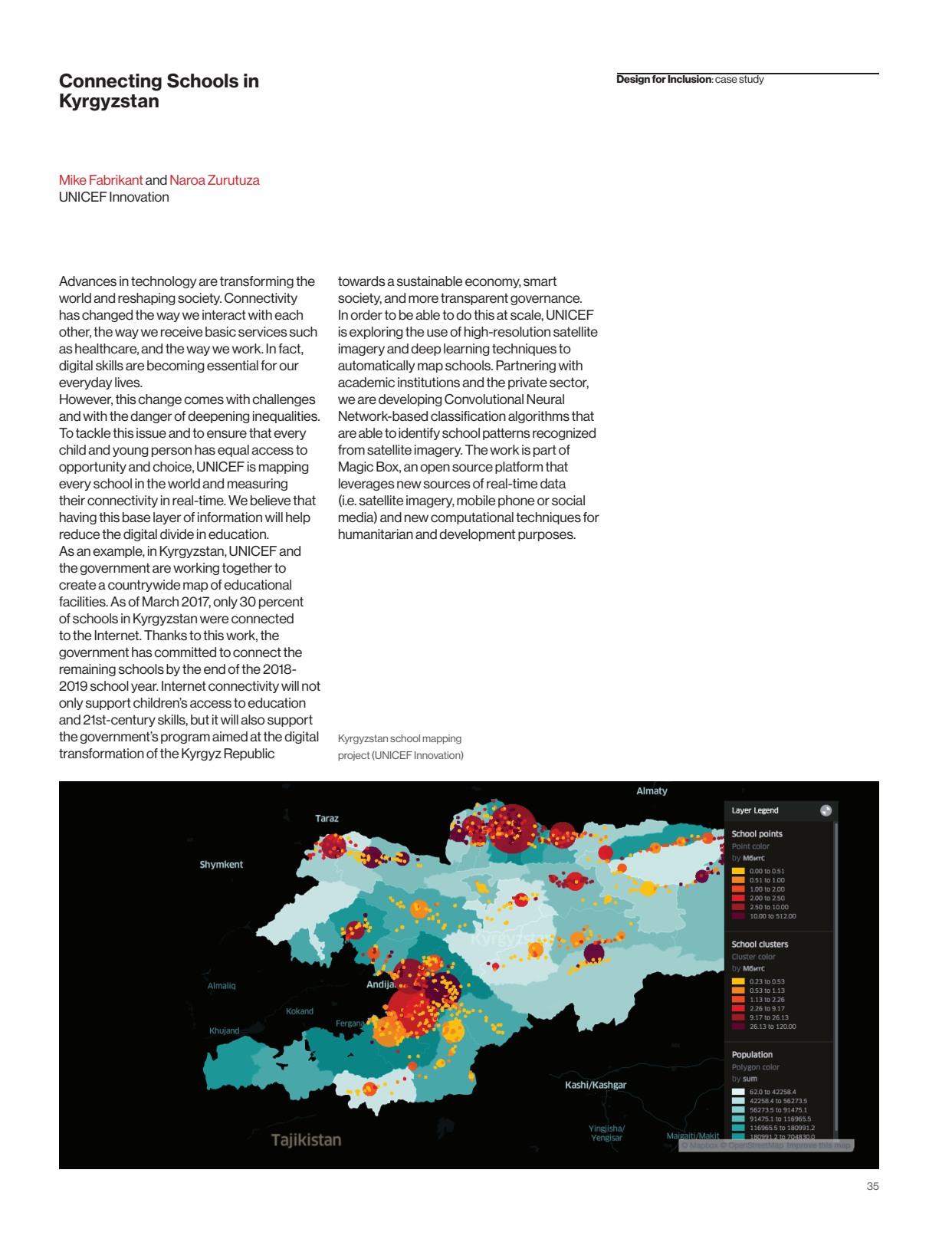
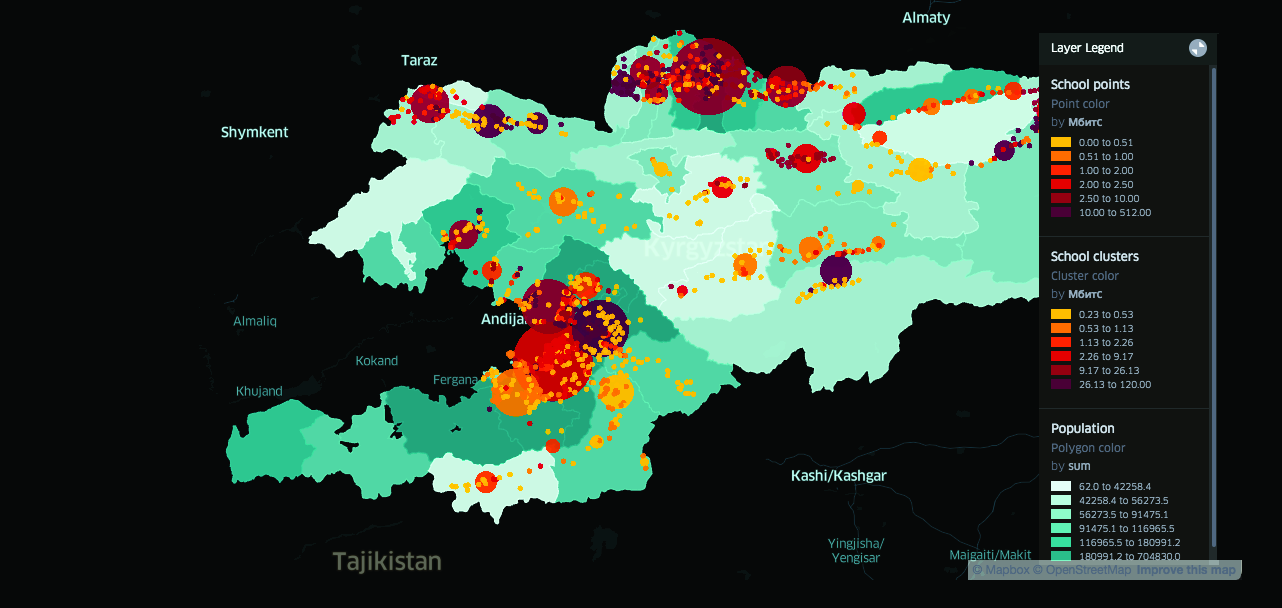
As an example, in Kyrgyzstan, UNICEF and the government are working together to create a countrywide map of educational facilities. As of March 2017, only 30 percent of schools in Kyrgyzstan were connected to the Internet. Thanks to this work, the government has committed to connect the remaining schools by the end of the 2018-2019 school year. Internet connectivity will not only support children’s access to education and 21st-century skills, but it will also support the government’s program aimed at the digital transformation of the Kyrgyz Republic towards a sustainable economy, smart society, and more transparent governance.
In order to be able to do this at scale, UNICEF is exploring the use of high-resolution satellite imagery and deep learning techniques to automatically map schools. Partnering with academic institutions and the private sector, we are developing Convolutional Neural Network-based classification algorithms that are able to identify school patterns recognized from satellite imagery. The work is part of Magic Box, an open source platform that leverages new sources of real-time data (i.e. satellite imagery, mobile phone or social media) and new computational techniques for humanitarian and development purposes.
Source & original pages
Transcribed for the web and checked against the original yearbook pages. Line wrapping and page layout have been adapted for screen reading; the authors’ wording is retained. Roles, references and descriptions are those of the original publication.
- The school connectivity figures and end-of-2018–2019 commitment are historical; they have not been presented as a current status update.
View the original page layouts