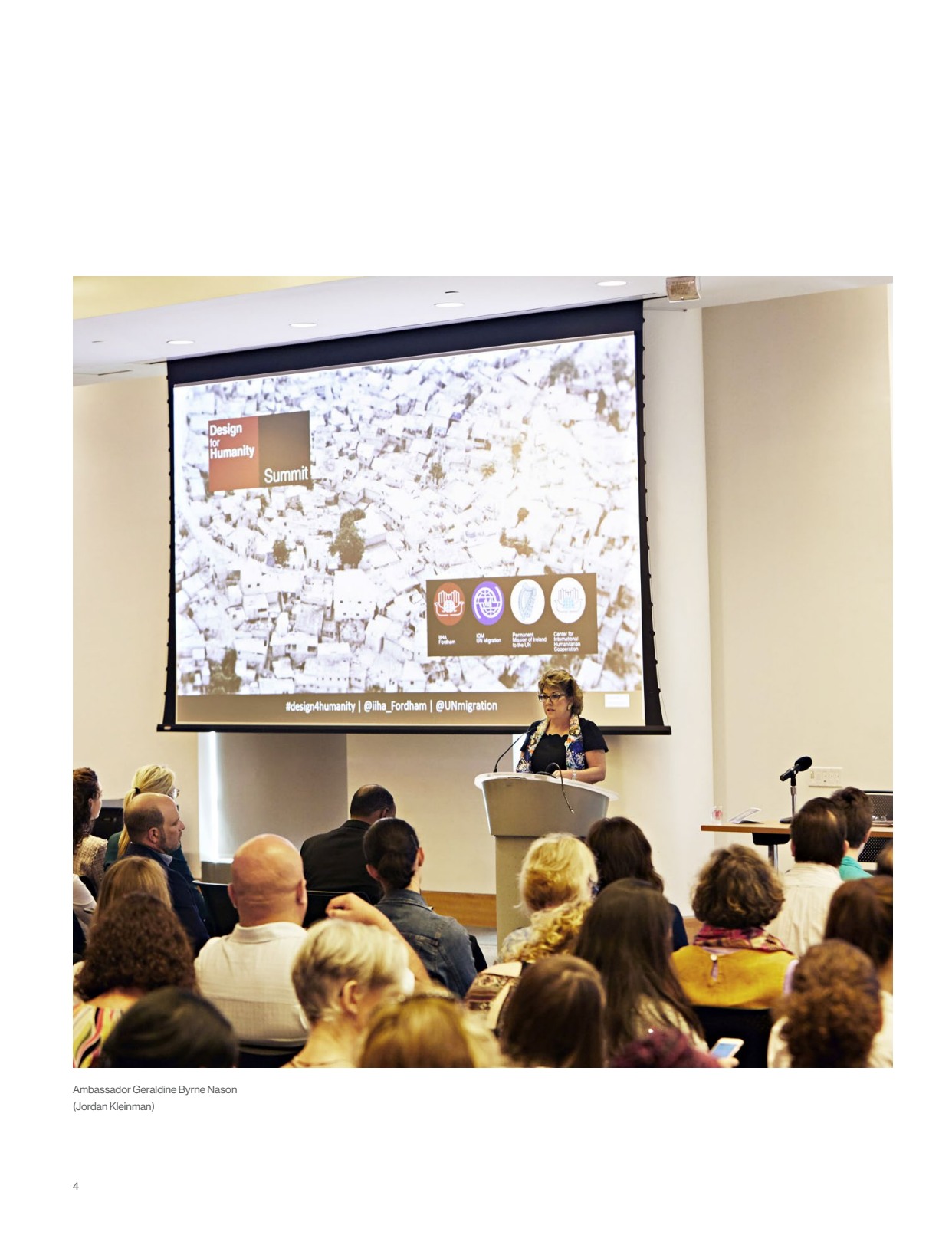
2018 / address
A Call to Action
Geraldine Byrne Nason — Permanent Representative of Ireland to the United Nations, Ambassador
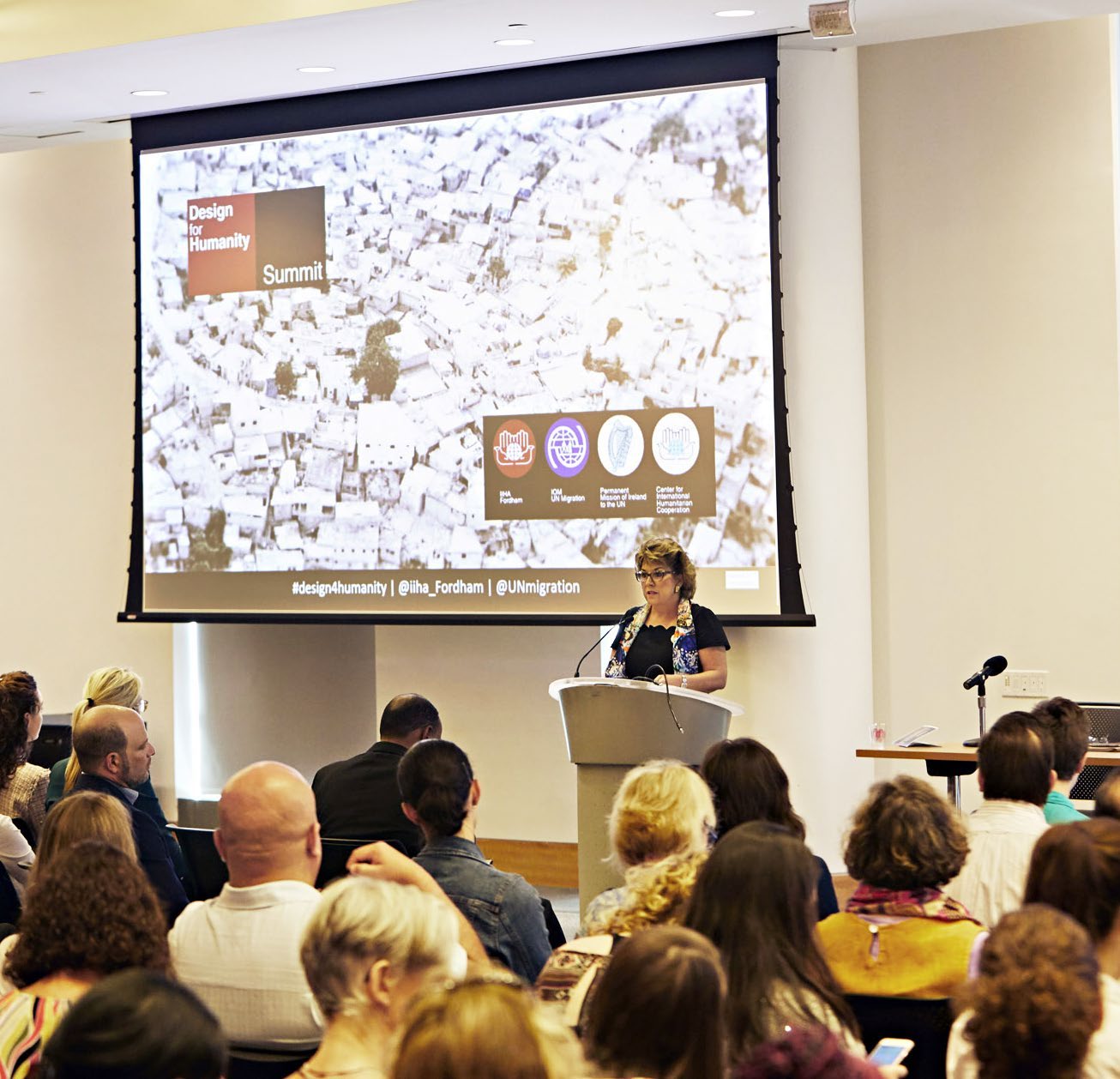
Recently, addressing the UN General Assembly, President of Ireland, Michael D. Higgins said, “Every generation, every age, must be allowed its own ‘aisling’ (gaelic for ‘vision’), its own dream for a better, kinder, happier, shared world.” This dream remains elusive.
Every two seconds, one person is displaced on our globe. Could there be any more powerful incentive for bringing us together, to look for a ‘Design for Humanity’, to look for new ways forward?
At the United Nations, day after day, meeting after meeting, we struggle to stem human suffering and tragedy. Famine, natural disasters, war. The interface between politics and humanitarian assistance is a very difficult one to navigate. While we focus at the UN on brokering political accords to end human suffering, Ireland remains focused on the ideal that we must never stray from the humanitarian principles. Put simply: those in need of humanitarian assistance must be helped and without delay.
In carrying out our work collectively, we have never had greater capacity, more resources and bigger data. And yet, we fail. We watch humanitarian actors constantly pick up the costly and tragic outcomes generated by our imperfect politics, in a world where it’s true, there are no second chances. My small, but courageous country with a big voice acts often in support of humanitarian efforts and often in defiance. We believe we must act now, before it is simply too late.
Ireland’s partnership with Fordham University is a DNA partnership, it’s a natural one. Fordham enjoys a legacy steeped in rich Irish history. Founded by the Bishop of New York and Irish immigrant, John Hughes, Fordham encapsulates Bishop Hughes’ vision of education as “the indispensable means for his immigrant flock to break out of the cycle of poverty to better themselves economically and socially in their adopted homeland”.
Rooted in those noble beginnings, the Institute of International Humanitarian Affairs has grown to become a world leader in humanitarian education, the Gold Standard, we believe.
The Design for Humanity Summit has an ambitious and shared vision for an ideal world.
The notion that we can end poverty, while the path will be long and winding, remains one to which we subscribe. We are determined to leave no one behind, reaching the furthest behind first.
Ireland’s own harrowing history of famine, mass migration and our struggle for independence and peace form the cornerstone of our identity. It continues to anchor, shape and in many ways, define our foreign policy today. Human rights, development, peacekeeping and disarmament remain front and center to how we choose to engage with the world around us. We believe nothing is wholly foreign or entirely domestic. The humanitarian response is at the heart of that instinct and informs the way we work every day at the UN.
At the Permanent Mission of Ireland to the United Nations, we listen, and ensure that Ireland’s voice is heard at decision-making tables. It is part of our DNA and central to our foreign policy.
A strong multilateral system is vital today at a time of increasing global insecurity and resultant humanitarian crises. We are a small country, and partly because of that, we believe we have a responsibility to fully engage in the UN. We listen to what others have to say and we speak up for those who need it.
Dag Hammarskjöld, the former UN Secretary-General once said, and I quote: “The United Nations was created not to lead mankind to heaven, but to save humanity from hell.” Indeed, the United Nations is faced with what can probably be deemed the ‘impossible task’ of bringing peace to the world.
Global challenges, climate change, conflict, displacement lead to heightened vulnerability.
Where chronic poverty, human rights violations and multiple shocks meet, our humanitarian and development actions prevent the conflicts of tomorrow, helping to address those root causes, supporting the local capacity and finding sustainable solutions.
We are proud to work with a range of trusted partners in response to those crises.
The Red Cross and Red Crescent Movement and NGOs play a critical role in delivering humanitarian action and in mobilizing public support, reaching the hardest to reach, those with the greatest needs. New actors, particularly the private sector, have much to offer by way of innovative solutions.
Personally, for me, what is most exciting about the Design for Humanity Summit, is the potential for us to bridge the gaps, to harness the possibilities and to unlock the solutions.
Together, if we can pool our expertise, I know that dignified design and durable solutions can empower those furthest left behind.
It seems fitting to finish with an old Irish proverb which resonates particularly with the theme of the Summit ‘Ar scáth a chéile a mhaireann na daoine’ which translates to, ‘It is in the shelter of each other, that we live.’
Source & original pages
Transcribed for the web and checked against the original yearbook pages. Line wrapping and page layout have been adapted for screen reading; the authors’ wording is retained. Roles, references and descriptions are those of the original publication.
View the original page layouts