

In the early Design for Humanity conversations, people working on shelters sat alongside people working on information, services, public space, technology and art. I remember the variety because it changed the scale of the discussion. An architect’s drawing and an operational procedure could both shape someone’s experience of arriving in a new place.
The challenge was to find a way of working across those perspectives without flattening their differences.
Fordham University’s Institute of International Humanitarian Affairs and IOM launched the Design for Humanity Initiative in 2018. The following year’s Summit explored, among other questions, the relationship between camps and communities, and between data and stories. [1] Looking back, I see those as invitations to examine what surrounds the things humanitarian organisations deliver: the neighbourhood around a dwelling, the rights and lives behind a dataset, the institutions around a service.
A practical design proposition
Casa Azul gave part of that conversation a concrete brief. Developed through IIHA, IOM and TAMassociati in the Venezuelan migration context, its playbook proposed adaptable spaces along migration routes, bringing information and assistance into proximity with social and cultural life. Cooper Hewitt included the project in Designing Peace. [2]
The aspect I keep returning to is the possibility of working with existing structures and different settings. That makes the receiving place part of the design problem. A concept has to meet an actual building, climate, neighbourhood, pattern of movement and set of institutions. It also has to meet the people who will use and maintain it.
For me, the interest in beauty and welcome belongs inside that encounter. Decisions about privacy, shade, materials, signage and room for social life communicate something about how people are expected to inhabit a place. Their meaning cannot be determined entirely by the person drawing the plan.
A playbook can make a proposition explicit and adaptable. Its publication, or inclusion in an exhibition, does not demonstrate the outcomes of every possible implementation. Those would need to be examined in their own settings. I want D4H’s future work to keep moving between the promise of an idea and the evidence of what happens when people use it.
What travels, and what must change?
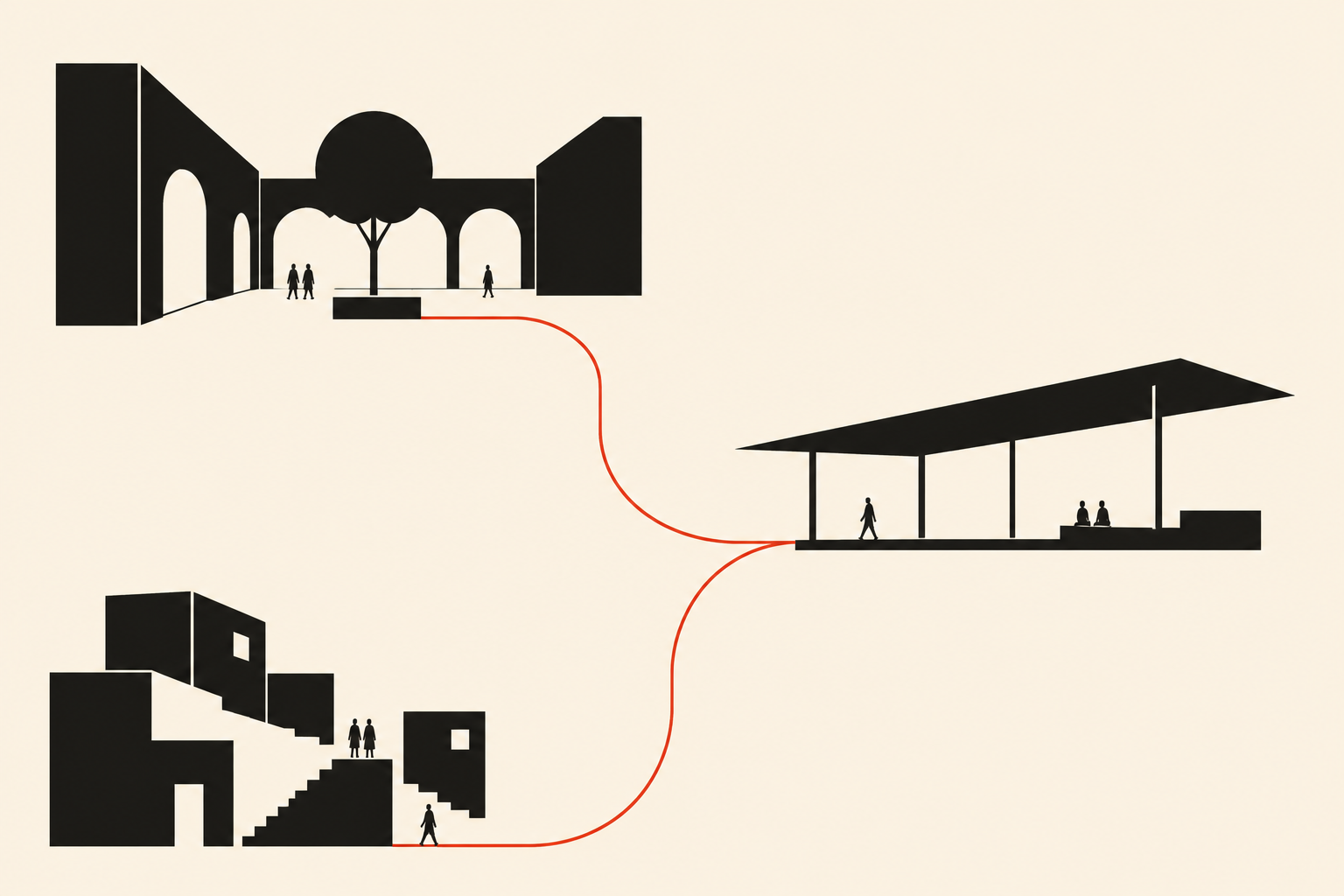
This is also a research question. If a design works somewhere, which parts of its usefulness depend on the place? Which depend on staffing, finance, legal authority or relationships that the drawing does not show?
Elrha’s learning from six innovation-adoption projects found that taking an existing approach into another setting could still require considerable adaptation, resources and partnership work. [3] That is a useful reminder for anyone hoping to share a method internationally. The organisation adopting an idea is doing design work too.
For the Journal, I would like to explore contributions that follow such a transfer. An originating team could explain its assumptions; a team elsewhere could describe what it retained, changed or rejected. People using the resulting service or space could examine the consequences. Each account would need its own evidence and authorship, rather than being arranged to confirm the original concept.
This could make local and global knowledge meet in a more demanding way. A local account would be valuable for the questions and explanations it contributes. Comparison would help identify where an approach travels and where it stops being useful.
A wider conversation, with clear responsibilities
Designers and humanitarians are essential to that work. So are municipal teams, researchers, local organisations and people with experience of displacement. Donor governments and foundations have a place because their choices shape the time, scope and resources available for adaptation and learning.
I would like those funding choices to be visible in the discussion. What could the implementing team change? What needed prior agreement? Was there support for follow-up once delivery ended? A serious account should allow examination of the commissioning arrangement as well as the intervention itself.
Participation in that conversation would not require agreement with every D4H proposition. Nor should funding or professional involvement put a claim beyond criticism. Contributions need clear attribution, relevant disclosure and enough editorial independence for difficult findings to remain publishable.
The Summits created encounters. The Journal can preserve the reasoning that emerges from them and bring it into contact with work taking place far beyond the original network. I hope it will also allow us to return to an idea after the enthusiasm of its launch: to see what endured, what changed and what someone else learned by trying to make it useful.
That is a future for Design for Humanity I would like to help build: a place where experience can travel with enough detail for others to question it, adapt it and contribute something of their own.
References
- IIHA, Design for Humanity history and Summit record:
- Cooper Hewitt, Casa Azul, Designing Peace. Establishes project concept, attribution and exhibition inclusion; does not constitute an impact evaluation.
- FLUSH Associates / Elrha, Adopting Humanitarian Innovation: Key Lessons from an Adoption Challenge, 2025. Six-project learning synthesis.
An essay from the editor. This is part of the public D4H conversation, separate from the forthcoming peer-reviewed Issue 01.
Continue reading